

Ornamental Iridescence:
Ecocide, the Colonial Imagination, and Martin Johnson Heade’s Gems of Brazil
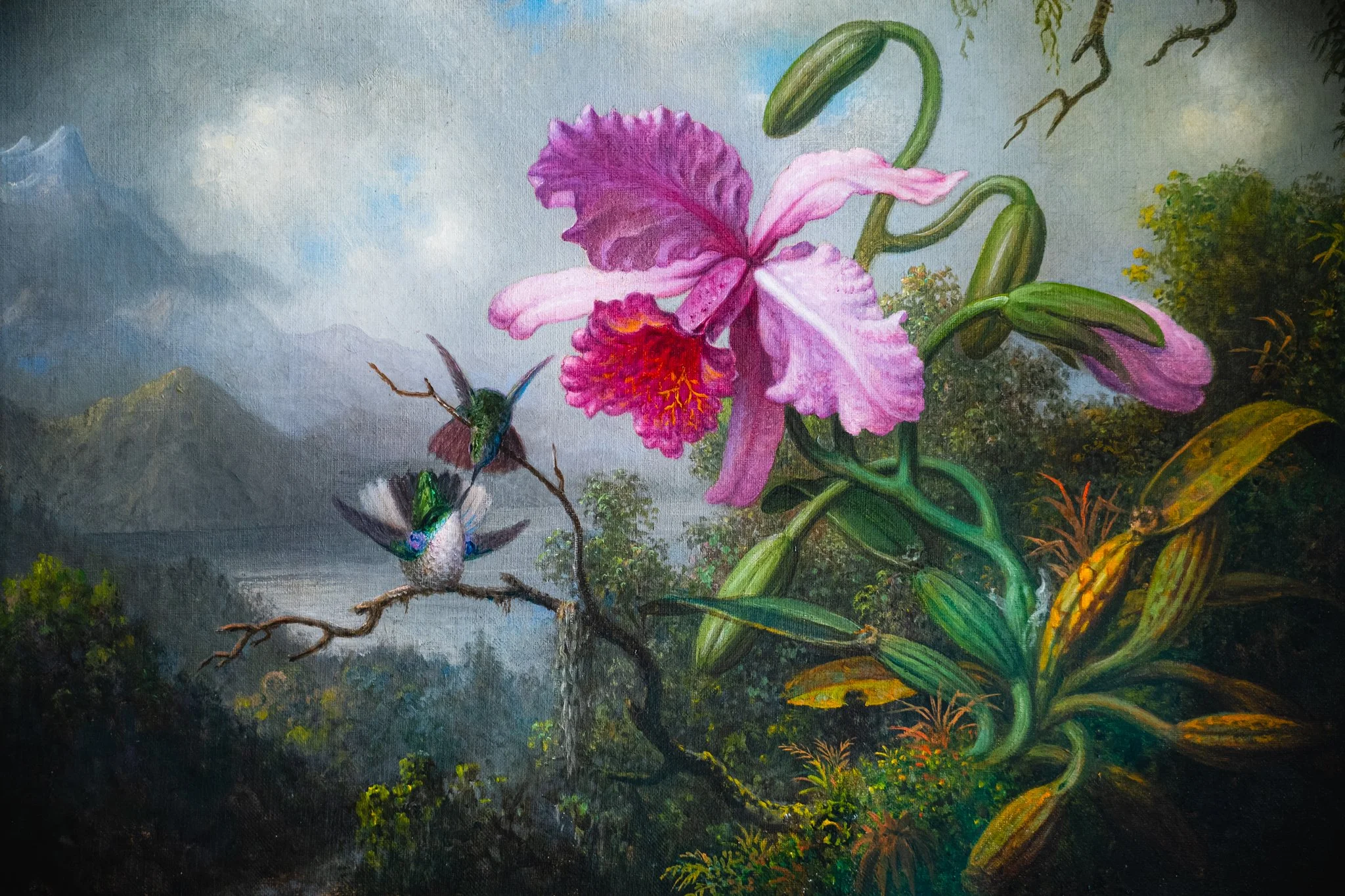
Ornamental Iridescence: Coloniality, Ecocide, and Martin Johnson Heade’s Gems of Brazil investigates how systems of representation shape not only what we are able to see, preserve, reproduce, and understand about the natural world, but also how living beings become objects of knowledge, aesthetic appreciation, collection, and control. Taking Martin Johnson Heade’s unfinished The Gems of Brazil (1863–64) as a point of departure, the project examines the entanglement of nineteenth-century natural history, coloniality, and the visual technologies through which tropical nature was transformed into images, specimens, and commodities.
During his travels in Brazil, Heade studied hummingbirds and tropical flora with the ambition of producing a lavish publication that would unite art and science through chromolithography. The project was ultimately abandoned, in part because contemporary reproductive technologies could not adequately translate the subtle colors, iridescence, and material qualities of his paintings. Yet the technological limits that frustrated Heade also reveal a deeper contradiction: the desire to make tropical nature visible, knowable, and reproducible was inseparable from systems of collecting, classification, circulation, and possession that transformed living organisms and ecosystems into objects of scientific and aesthetic knowledge.
More than 150 years later, I return to Gems of Brazil through contemporary imaging while critically examining the colonial structures embedded in its production and legacy. Combining high-resolution photography, moving image, archival research, and field observation, I will photograph hummingbirds, orchids, and other tropical flora within their contemporary ecologies while examining Heade’s paintings, pigments, specimens, and historical methods of reproduction. Research at collections including the Harvard Museum of Comparative Zoology and the American Museum of Natural History will inform a reconstruction of Heade’s material practice while situating Gems of Brazil within broader histories of natural-history illustration, taxonomy, collecting, taxidermy, the feather trade, and the extraction and circulation of biological and ecological knowledge.
The project uses coloniality as a framework for examining how these histories undergird, as well as continue beyond, the formal end of colonial rule: in systems of classification and scientific authority, in the movement of specimens and knowledge across geographic and institutional boundaries, and in the transformation of living beings into aesthetic, scientific, and economic resources. It also considers ecocide as both a material condition and a complex epistemic problem. The histories of collecting and extraction that made tropical nature available for study and display are connected to contemporary forms of habitat destruction, biodiversity loss, and the ongoing commodification of nonhuman life. The project therefore asks not only how nature has been represented, but what kinds of relationships to the living world those representations have enabled.
By bringing Heade’s nineteenth-century project into dialogue with contemporary ecological observation and imaging technologies, Ornamental Iridescence investigates the tension between the impulse to preserve nature through representation and the historical systems that have contributed to its displacement, commodification, and destruction. Contemporary photography and moving image become not simply improved tools for reproducing color and detail, but means of questioning the epistemological and political assumptions inherited from earlier technologies of seeing. What does it mean to photograph a species in an era of ecological crisis? What is preserved when an organism becomes an image, and what remains absent? Can representation move beyond the logic of possession and classification toward intervention and an account of ecological interdependence?
The resulting body of work will comprise a photographic series and serve as the foundation for a photobook and accompanying documentary film. Rather than reproducing Heade’s imagery, the project uses his unfinished publication as a site through which to examine the intertwined histories of art, science, coloniality, extraction, and ecological destruction. Ornamental Iridescence ultimately asks how technologies of seeing participate in the ways we relate to living systems, and if/how new forms of representation can help us imagine relationships to the natural world that are not organized around possession, extraction, and control.
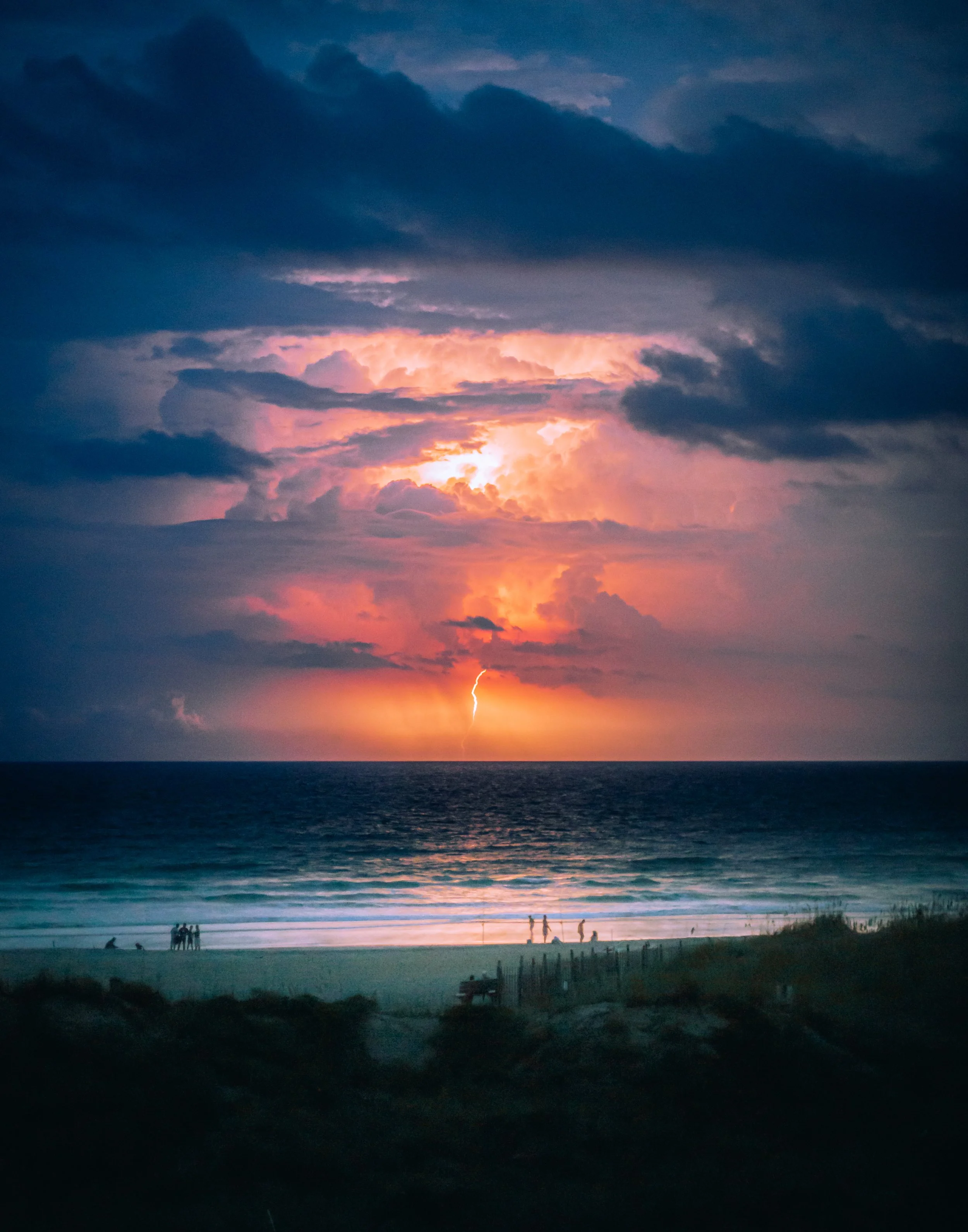
Tempest: Thunderstorm Approaching Wrightsville Beach
Lightning strikes the ocean beyond Wrightsville Beach as a storm gathers along the horizon. The fleeting illumination recalls Martin Johnson Heade’s repeated fascination with thunderstorms, atmospheric instability, and the visual drama produced when light, water, and weather converge. For Heade, atmospheric conditions were not simply settings for his subjects but phenomena worthy of sustained observation. Here, contemporary digital photography records an event that exists for only a fraction of a second, using the camera’s ability to capture and preserve transient light as a form of contemporary natural-history observation.
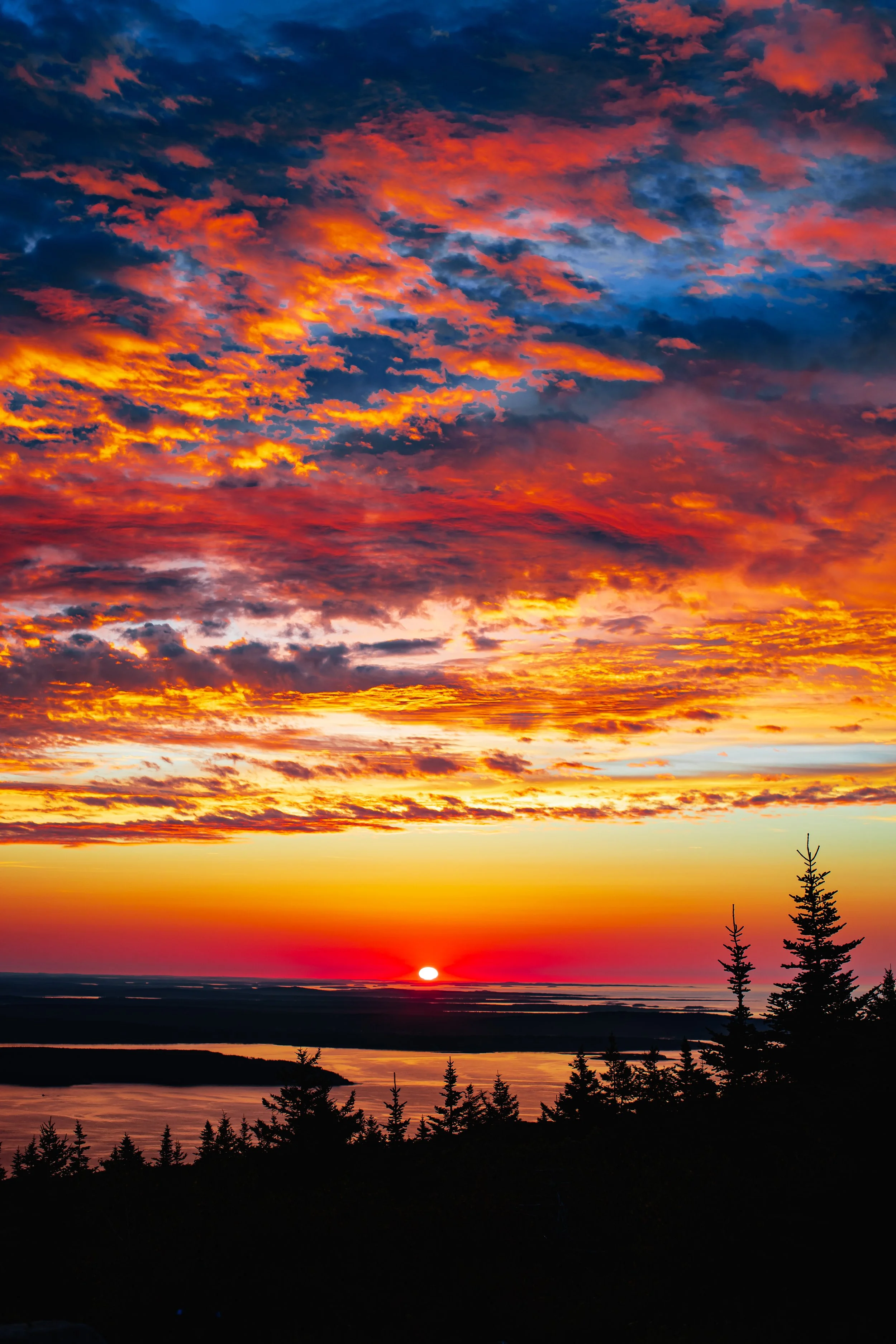
Sunrise from Cadillac Mountain, Acadia National Park
The sun emerges above the horizon, illuminating clouds in vivid orange while the trees remain in silhouette. The image recalls the luminist landscapes associated with Martin Johnson Heade, whose paintings treated light and atmosphere as subjects in themselves. Heade repeatedly explored sunrise, sunset, haze, and changing atmospheric conditions, using subtle variations in illumination to transform the landscape through perception. Contemporary digital photography extends this investigation through a different technology of seeing, preserving minute variations in color and luminosity across a range that exceeds the fleeting experience of the human eye.

Stillness: Sunset, Lake Champlain
A pink sunset settles over the snow-capped Adirondacks as the Burlington Breakwater Lighthouse stands at the edge of Lake Champlain, bringing together mountain, water, architecture, and fading light in a moment of atmospheric stillness. The image directly recalls Martin Johnson Heade’s Sunset: Lake Champlain (1874), which similarly transforms the lake and surrounding mountains through subtle variations of color, light, and atmosphere.
Heade returned repeatedly to Lake Champlain, treating its changing skies and atmospheric conditions as subjects worthy of sustained observation. His Sunset belongs to the same broader investigation of transient light that runs through his landscapes and later hummingbird paintings. By photographing the same landscape more than a century later, I am interested not in reproducing Heade’s image, but in entering into dialogue with his practice of attentive looking. Contemporary digital photography provides a different technological means of preserving fleeting variations in color and luminosity, while the continuity of the landscape invites reflection on what has changed—and what persists—within our relationship to place, light, and the natural world.
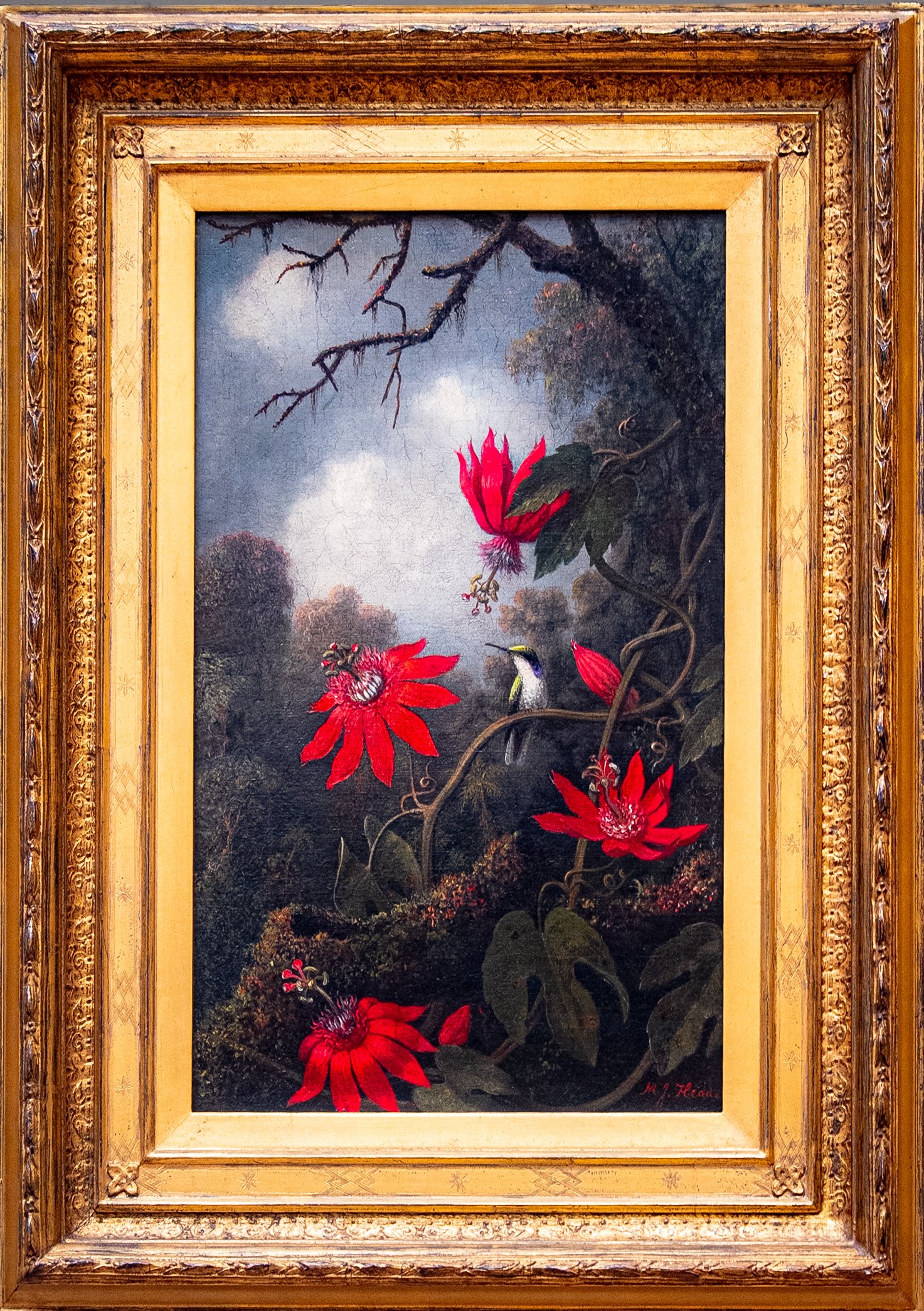
Hummingbird and Passionflowers, Martin Johnson Heade
This painting is part of my art-historical study of Martin Johnson Heade and the histories surrounding The Gems of Brazil. Heade occupied an unusual position between landscape painting, natural-history observation, and scientific illustration. His fascination with hummingbirds led him to Brazil in 1863, where he studied specimens and plants while developing The Gems of Brazil, an ambitious publication combining scientific observation with the visual richness of his paintings.
Influenced by the scientific writings and illustrations of figures like Darwin, Gould, and Audubon, Heade emphasized relationships between flora and fauna. His later hummingbird-and-flower paintings drew on Brazilian specimens and natural-history research while also incorporating invented, idealized settings and taxidermied birds.
Photographing Hummingbird and Passionflowers is both an encounter with an individual artwork and part of my study of Heade’s methods, influences, and position between art, science, and technology. It also extends the project’s central investigation of reproduction: where Heade struggled to reproduce color through chromolithography, we are able to use contemporary high-resolution digital imaging to examine how contemporary technology translates pigment, surface, iridescence, and botanical detail into data—and what is revealed or lost in the process.
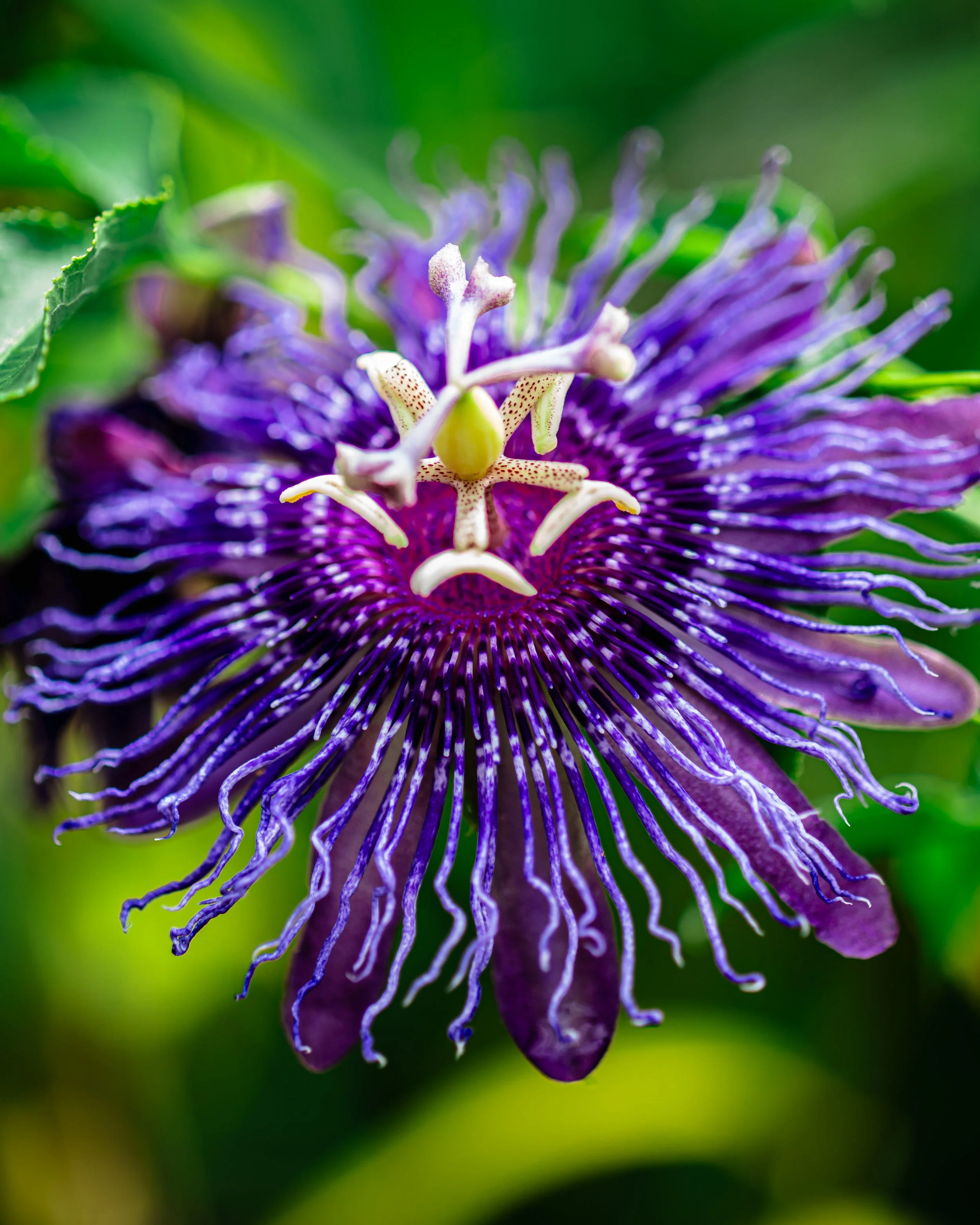
Passiflora: Purple Passionflower
Seen through a macro lens, the passionflower becomes a landscape of intricate filaments, saturated color, and radial symmetry. Heade repeatedly incorporated passionflowers into his paintings of hummingbirds, treating botanical form as an essential component of the tropical environments he sought to represent. Here, the camera reverses that relationship, isolating the flower and magnifying structures invisible at ordinary scale.
Contemporary macro imaging extends Heade’s impulse toward close observation while introducing a new scale of perception. Texture, color, structure, and reflected light become visible as material phenomena, transforming a familiar flower into an unfamiliar world.
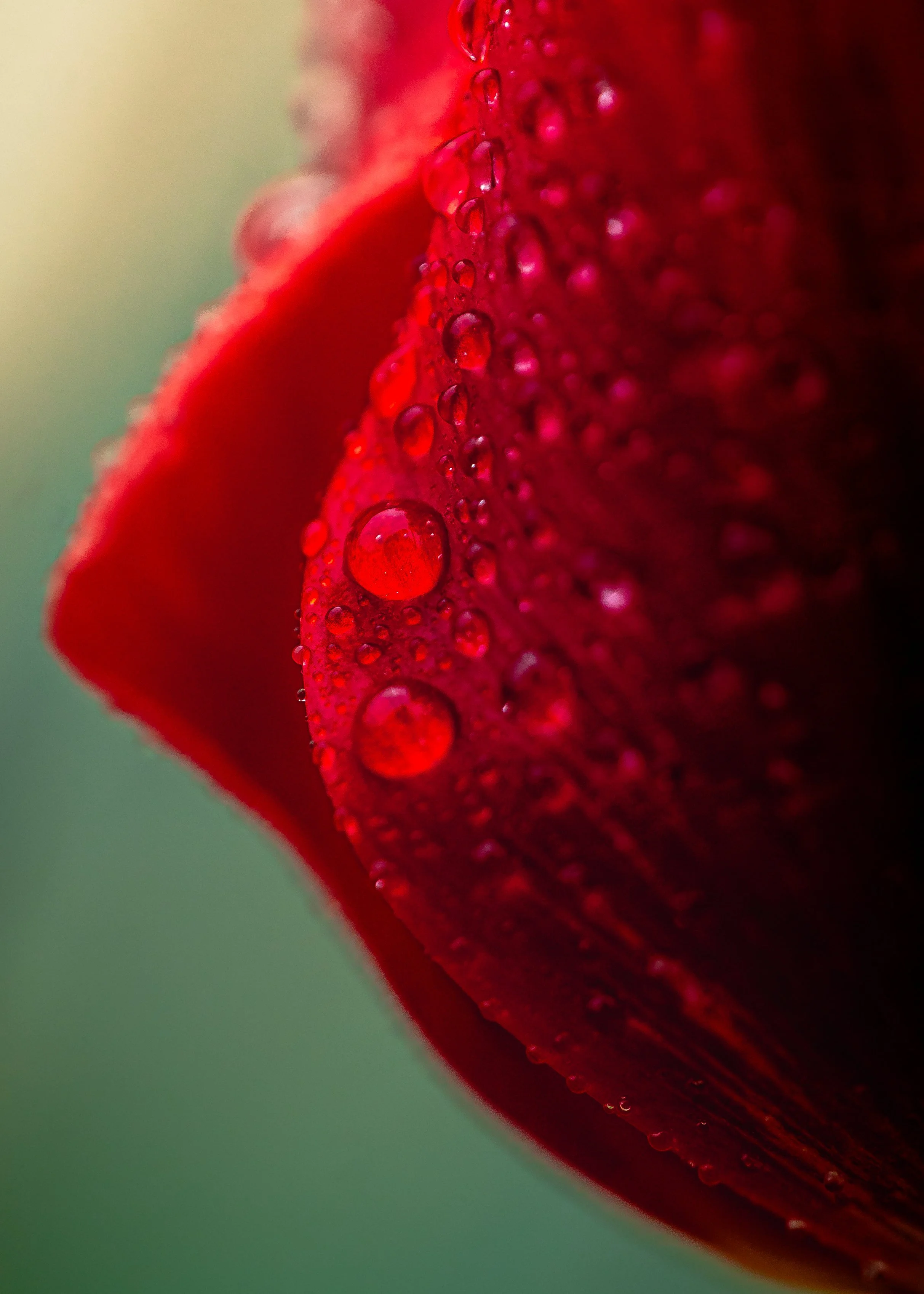
Crimson Droplets: Tulip in Morning Dew
A bright red tulip emerges from the morning light, its curved petals saturated with color and covered in translucent droplets of dew. At macro scale, water becomes a field of lenses across the flower’s surface, catching and refracting light while revealing the fine texture and folds of the petals.
The photograph furthers my practice in composition, color, and close observation while engaging a photographic tradition of finding complexity in the details of the everyday. Inspired by still life painters like Martin Johnson Heade & Charles Ethan Porter and photographers like Robert Mapplethorpe & Aaron Siskind, in my practice, attention to texture, surface, pattern, and the transformation of ordinary subjects through close observation offers an important precedent for this approach. I am interested in the moment when a recognizable subject begins to become something more abstract—when a flower becomes color, texture, light, and form.
Within Ornamental Iridescence, the image also serves as a study in the visual language I will bring to tropical flora. Contemporary macro imaging allows these minute structures and transient qualities to be recorded with extraordinary precision, extending the project's larger investigation of how photographic technologies alter our perception of the natural world.
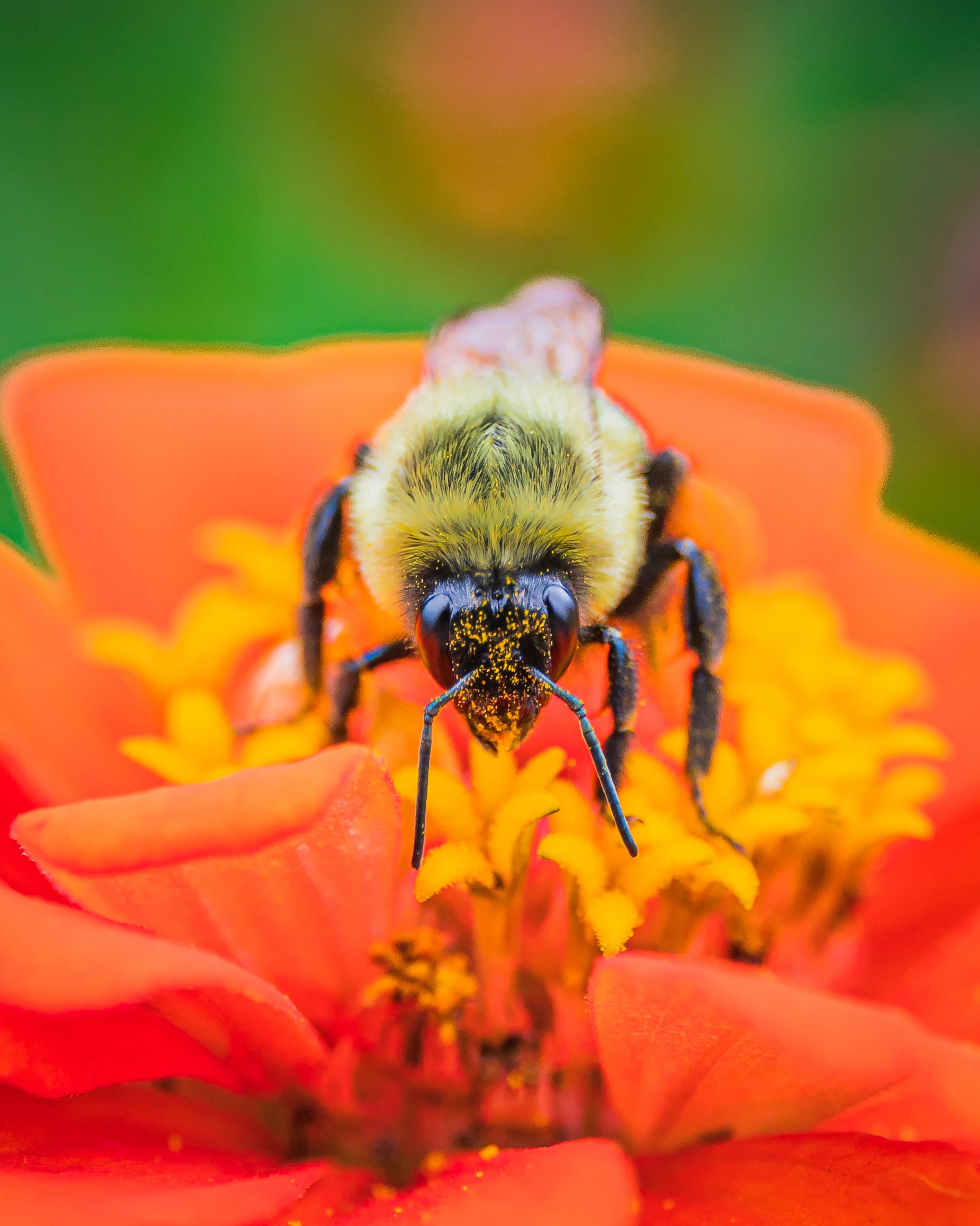
Pollenate: Bumblebee on Orange Zinnia
A bumblebee emerges from an orange zinnia covered in pollen, its body becoming a living record of the flower it has visited. At macro scale, individual grains become visible against the bee’s textured body, collapsing the distance between pollinator and plant. The image makes tangible a relationship ordinarily perceived only in passing: the bee gathers resources while carrying pollen between flowers, participating in the reproduction of the plants on which it depends.
The photograph extends Heade’s practice of bringing animals and plants into visual relationship while shifting the emphasis toward ecological interdependence. Color becomes biological information—the orange of the flower, yellow pollen, and dark body of the bee forming a composition in which aesthetic beauty and ecological function are inseparable.
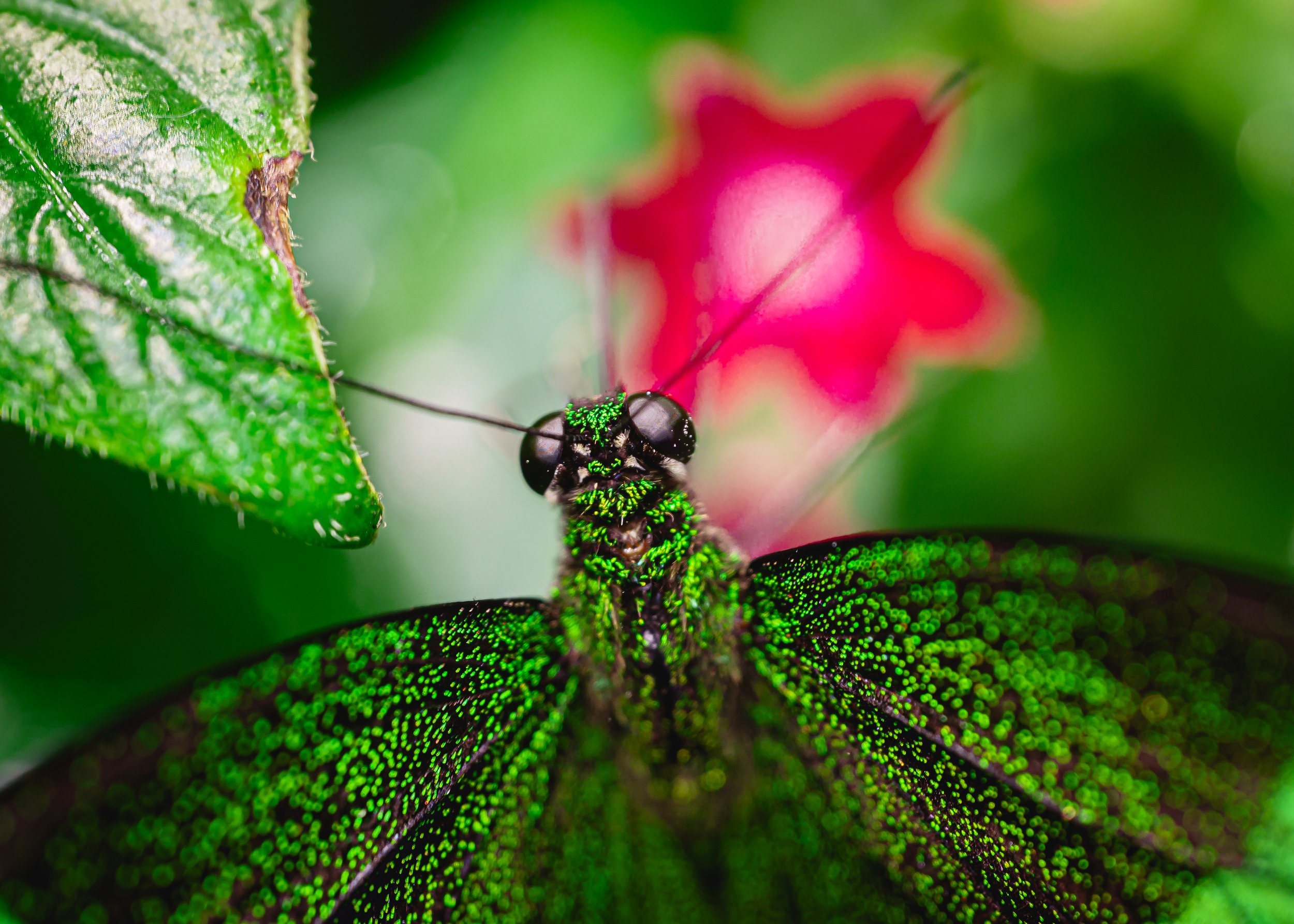
Emerald Iridescence: Swallowtail
At macro scale, the swallowtail’s wings become a field of luminous green, their apparent color shifting with the interaction of light and the microscopic structures of the wing scales. The image considers iridescence not simply as a visual quality, but as a material phenomenon produced through the relationship between biological structure, light, and perception.
This investigation parallels my interest in Heade’s hummingbirds, whose extraordinary colors similarly resist simple reproduction. By using contemporary macro imaging to reveal structures beyond ordinary vision, the photograph asks how technology can transform biological color from something merely observed into something investigated.
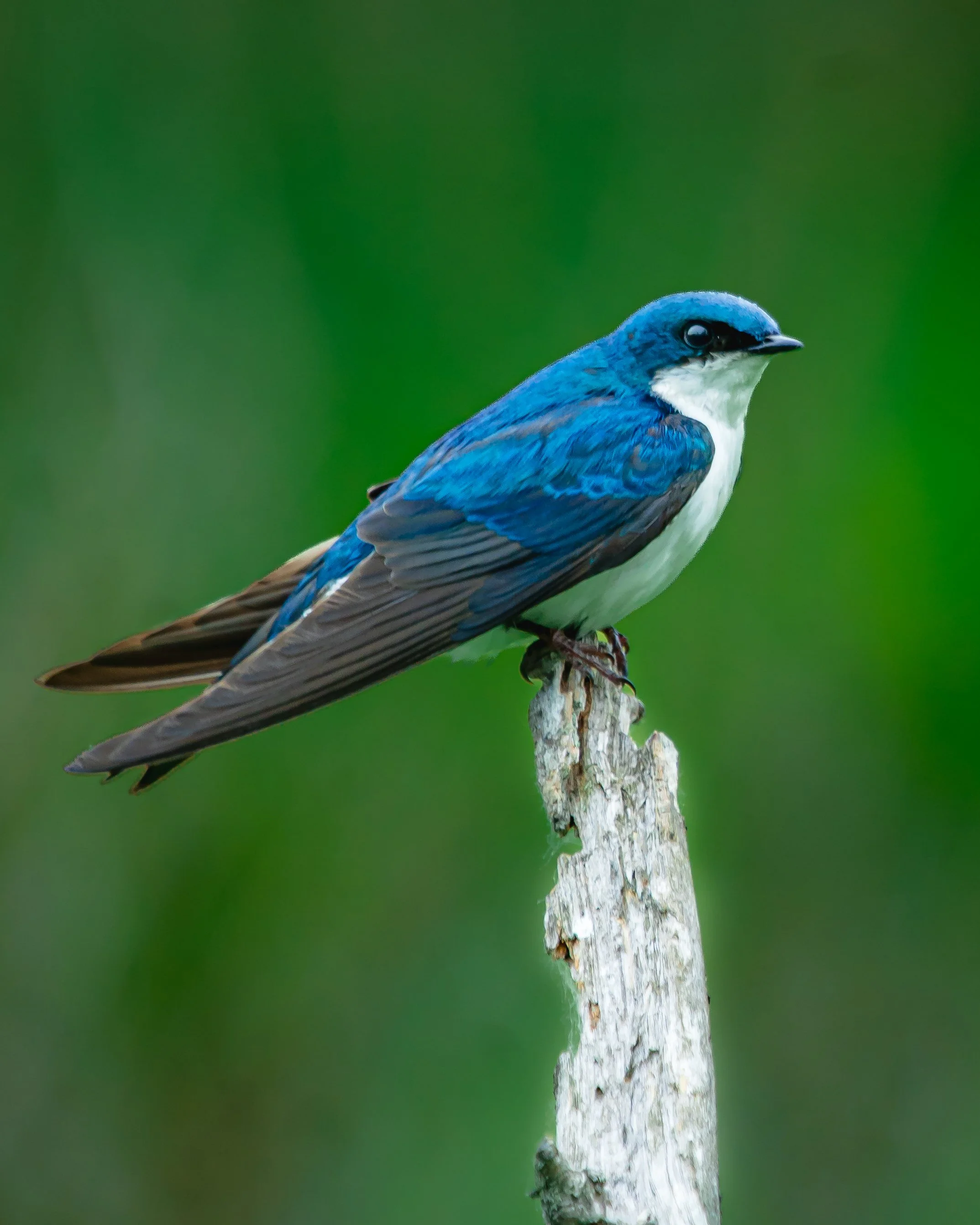
Sapphire Iridescence: Perching Tree Swallow
A Tree Swallow perches at the top of a tree emerging from a marsh, its dark wings catching the light and revealing flashes of luminous blue. The apparent simplicity of the bird’s plumage gives way, upon close observation, to an extraordinary optical phenomenon: color that seems to shift and intensify with the angle of illumination and the position of the viewer.
This iridescence provides a point of departure for my interest in Martin Johnson Heade’s hummingbirds, whose jewel-like feathers similarly challenge the idea of color as a fixed property. In both hummingbirds and swallows, structural coloration emerges through the interaction of microscopic biological structures, light, and perception. The camera can freeze a moment in which this color becomes visible, but it cannot separate the phenomenon from the conditions that produce it.
Photographing iridescent birds therefore becomes an investigation into the limits and possibilities of photographic representation. Contemporary imaging allows me to study fleeting variations in color at a level of detail unavailable to Heade, while raising the same fundamental question that confronted his attempts at chromolithographic reproduction: how can a technology of representation convey a color that changes as we look at it?
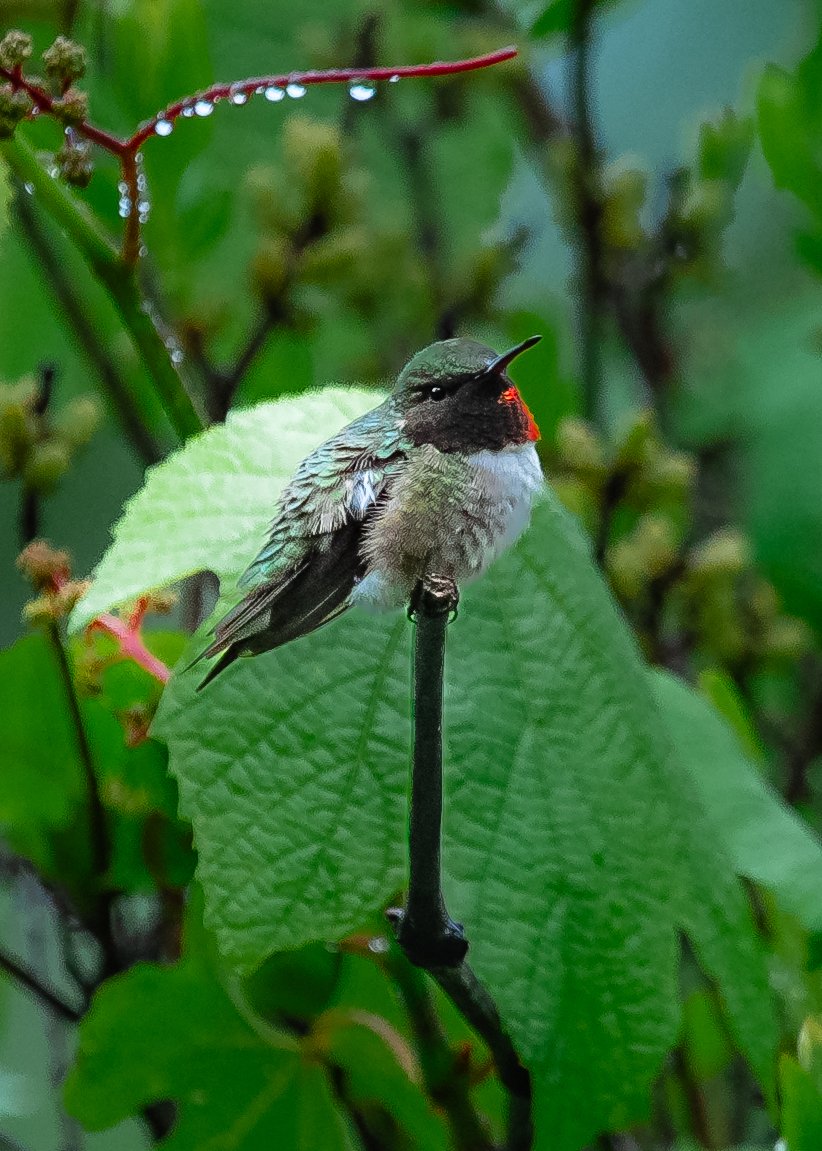
Ruby Iridescence: Male Ruby-Throated Hummingbird
A male Ruby-throated Hummingbird pauses on a branch and looks directly toward the camera. A shift in illumination catches the iridescent feathers along the left side of his throat, transforming them momentarily into luminous red. The Ruby-throated Hummingbird is the only hummingbird species that breeds in the eastern United States, making it an important contemporary point of departure for my return to Heade’s tropical hummingbirds.
The photograph also demonstrates the central optical problem at the heart of this project: iridescent color is not fixed, but changes with light, angle, structure, and observation. Contemporary high-resolution imaging can freeze this fleeting phenomenon at a level of detail unavailable to Heade, while also revealing the limitations of any single photographic representation. My experience photographing birds provides the technical foundation for this work—anticipating behavior, working at extreme focal lengths, and responding to fleeting changes in light and movement.
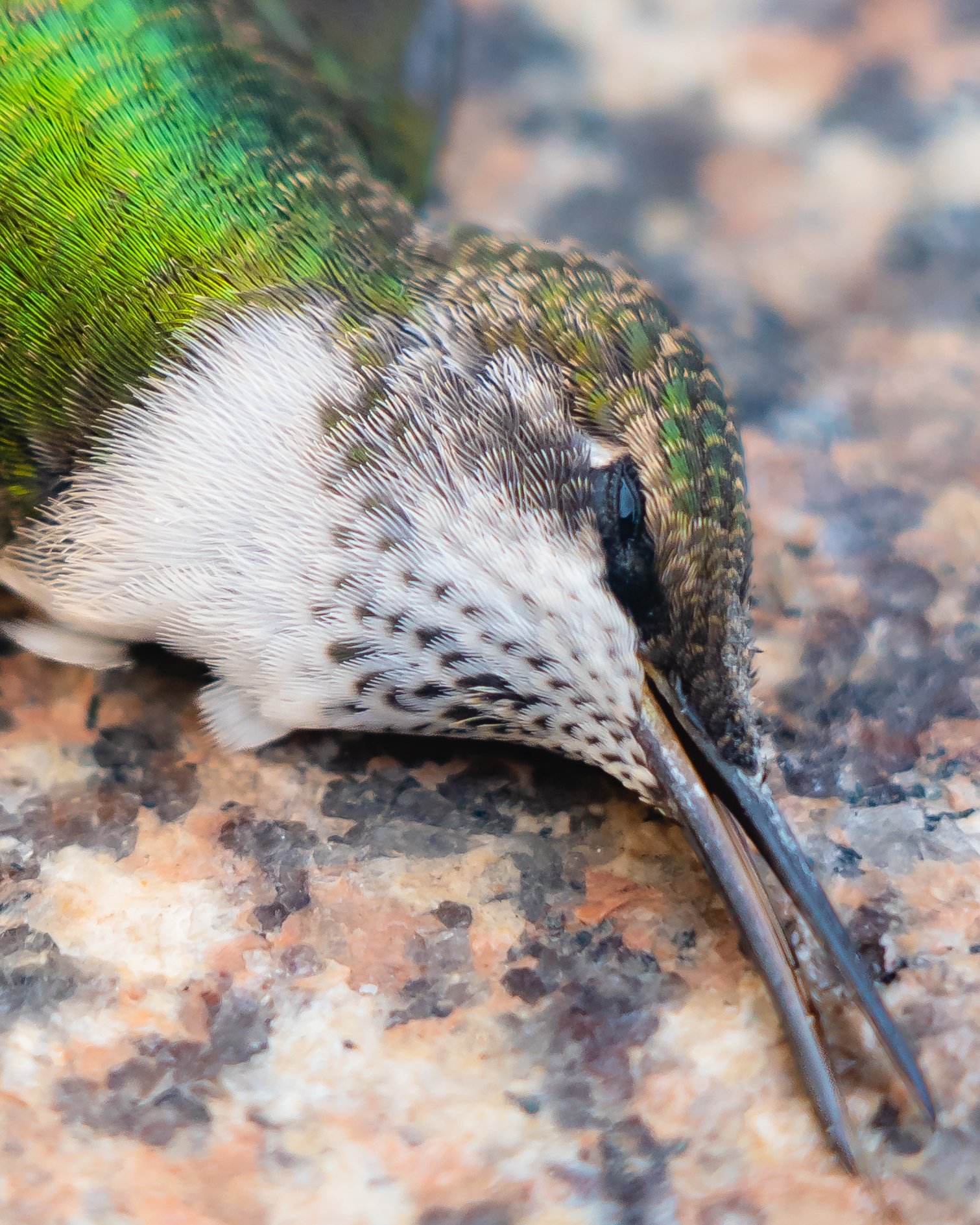
Interruption: Lifeless Hummingbird
A female Ruby-throated Hummingbird lies lifeless on a sidewalk after striking a window. Her body retains the intricate structure and coloration that make hummingbirds appear almost ornamental, but the photograph records an animal no longer participating in the living systems that produced those qualities.
The image introduces mortality into my investigation of hummingbirds and the technologies through which they have been represented. Heade’s hummingbirds were informed by specimens, collecting, and taxidermy: animals removed from their environments and transformed into objects of study and representation. Here, a contemporary bird becomes an unintended specimen through an encounter with the built environment. The camera preserves what remains, while also documenting the ecological conditions surrounding the image.
Window collisions are one of the largest human-caused sources of bird mortality in North America, with estimates of over one billion bird deaths annually from building and window collisions in the United States. Habitat loss, climate change, migration pressures, and other forms of environmental change compound these threats. The individual bird therefore becomes an entry point into a larger question of ecological interdependence: what happens when the environments constructed for human perception and habitation become dangerous to the species living alongside us?
Within Ornamental Iridescence, the photograph complicates the idea of the bird as an object of beauty or observation. The same body that can appear jewel-like through a camera lens is also a living organism dependent upon habitat, food, migration routes, and a landscape increasingly altered by human infrastructure. The image asks what contemporary technologies of representation can reveal about that vulnerability—and whether making an animal visible can also make visible the systems upon which its life depends.
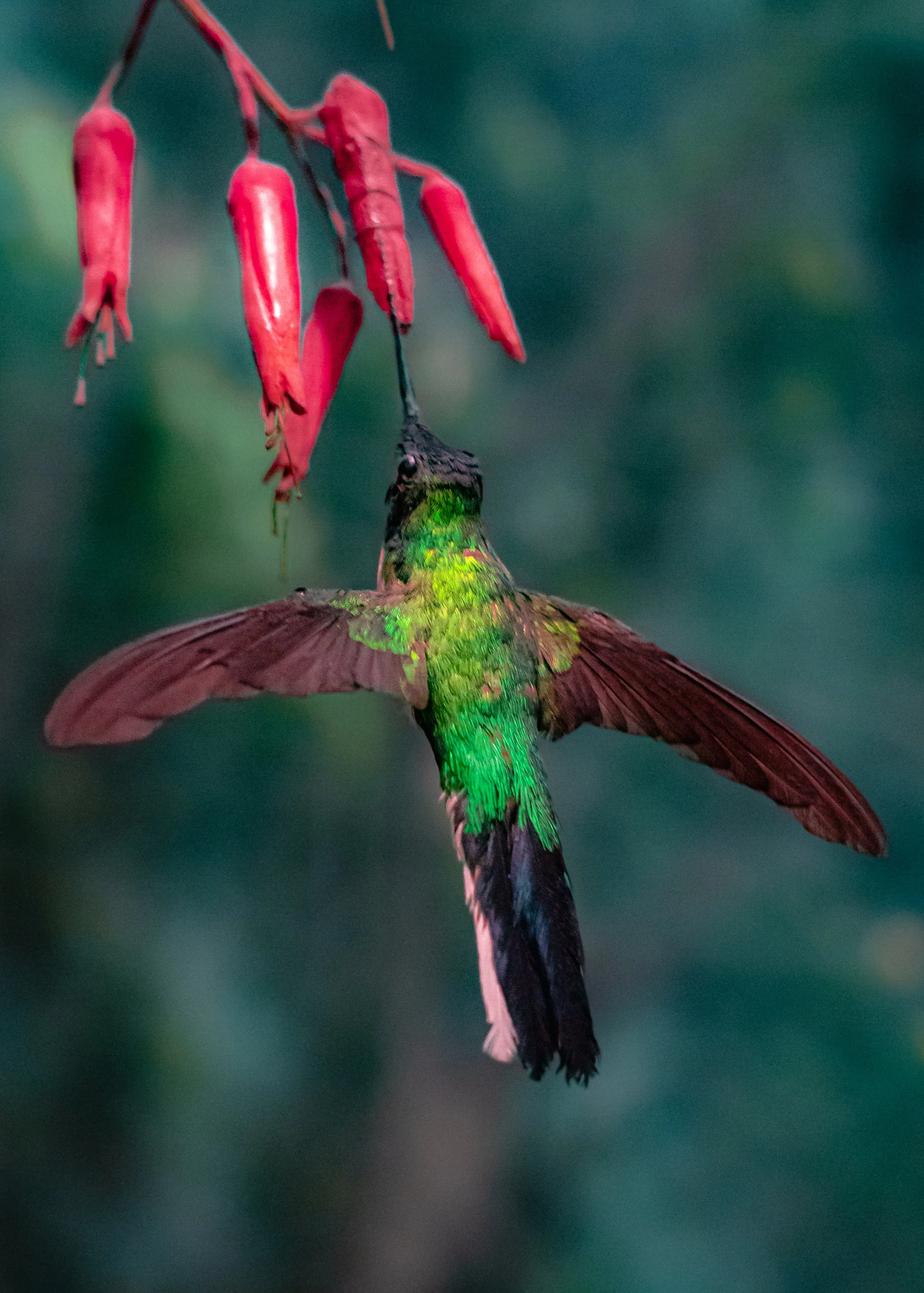
Ruby Iridescence: Male Ruby-Throated Hummingbird
A taxidermy specimen of a Purple-crowned Fairy Hummingbird is preserved within the collections of the American Museum of Natural History. Unlike the Coquette specimen photographed against the sterile white of the museum collection, this image places the bird within a constructed botanical environment inspired by the backdrops Martin Johnson Heade created for his hummingbird paintings.
Heade’s birds were not simply depicted as isolated specimens. He surrounded them with carefully arranged foliage, flowers, branches, and atmospheric effects that suggested the complexity of tropical habitats while often combining observed natural forms with invented or idealized settings. The resulting images occupy an uncertain space between scientific observation and artistic construction: the bird appears to inhabit a landscape, but that landscape is itself a technology of representation.
By recreating this strategy around a preserved specimen, the photograph makes visible the artificiality underlying the appearance of natural history. The taxidermied bird is already removed from its ecological context; the constructed backdrop gives it another environment, one designed to make the specimen appear alive within a recognizable world. This contrasts sharply with the white archival backdrop of the Coquette, where the specimen is presented primarily as an object for classification and preservation.
The two approaches reveal different technologies of seeing. The white background isolates the bird as an object of scientific knowledge, while the constructed habitat restores an illusion of ecological relationship. Both are artificial, but they produce different understandings of what the bird is: specimen, image, organism, or inhabitant of a living world.
Within Ornamental Iridescence, the photograph returns to the problem at the center of Heade’s Gems of Brazil: how can an image represent not only the appearance of a species, but the environment, relationships, and material conditions that constitute its life? Here, the backdrop becomes part of that question—a reminder that every representation of nature is also a construction.
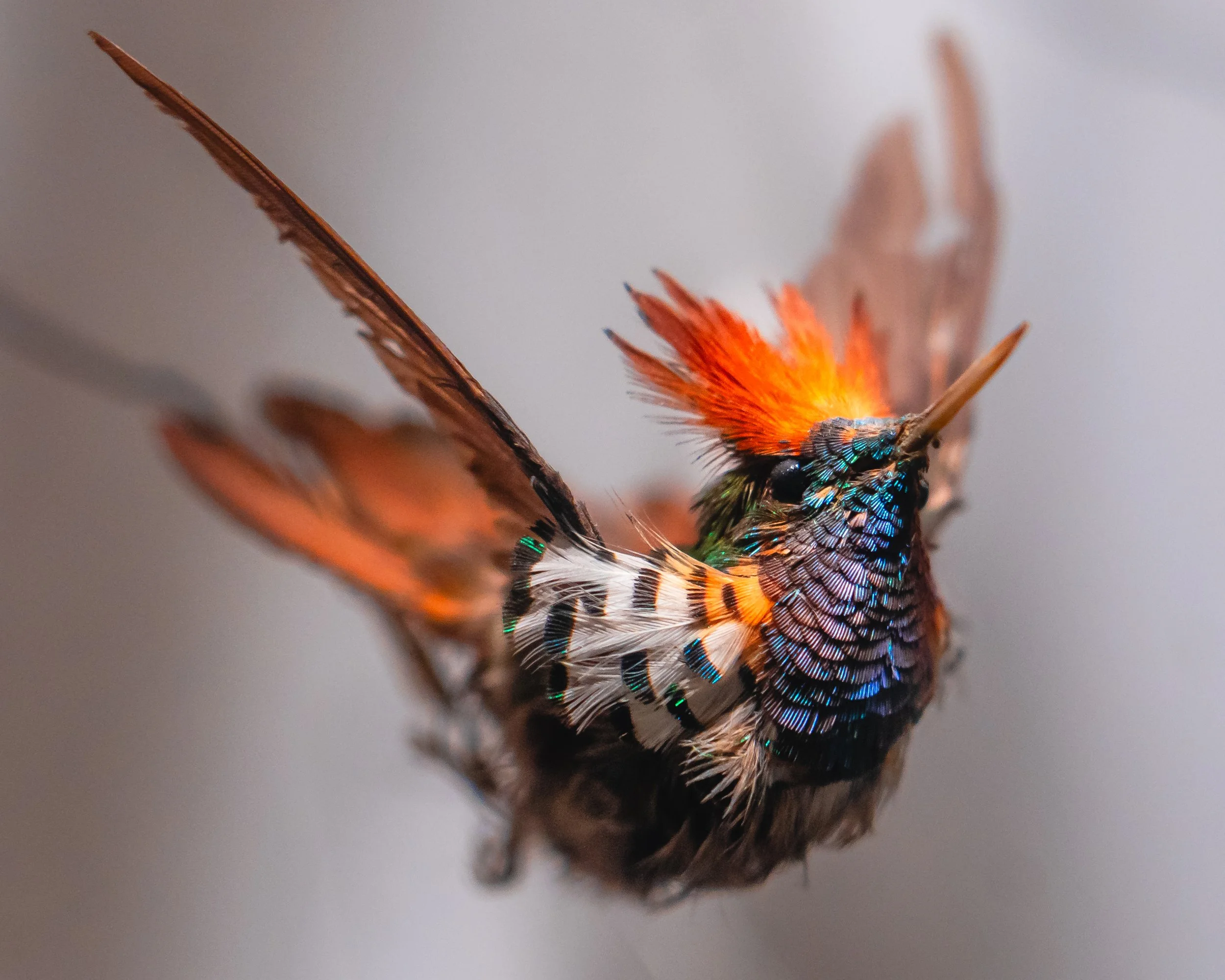
Lifelike: Coquette Hummingbird
A taxidermied coquette hummingbird rests inside the collections of Harvard University’s Museum of Comparative Zoology, preserved more than a century after naturalists and artists transformed hummingbirds into objects of scientific study, artistic representation, and display. The specimen is both an individual bird and a historical record of the systems through which tropical nature was collected and made visible.
For nineteenth-century figures such as Martin Johnson Heade, John Gould, and John James Audubon, preserved birds were essential tools of observation. Gould built his monumental studies of hummingbirds from collected specimens, ultimately assembling more than 5,000 hummingbird skins in his personal collection. Audubon likewise depended upon collected birds for his natural-history studies, while Heade occupied a more complicated position: during his 1863–64 journey to Brazil for The Gems of Brazil, he sought to observe hummingbirds alive in their native environments but also collected and studied specimens.
The practice was expensive, labor-intensive, and fundamentally counterintuitive to contemporary ideas of conservation. A bird had to be killed in order to become a specimen that could be transported, compared, illustrated, catalogued, and preserved. The nineteenth-century demand for skins extended far beyond individual artists and scientists: by the late nineteenth century, the hummingbird trade had reached extraordinary scale, with thousands of skins entering European markets and collections.
The consequences of this collecting culture remain difficult to separate from the broader history of habitat destruction, commercial exploitation, and other pressures on birds. Since Heade began The Gems of Brazil in the 1860s, at least two hummingbird species are recognized as extinct—Brace’s Emerald and Gould’s Emerald—while several additional taxa are considered possibly extinct or remain unresolved. The Turquoise-throated Puffleg, for example, is known from historical specimens but has not been reliably recorded for decades and is considered Critically Endangered, possibly extinct. The Coppery Thorntail is known from only two nineteenth-century specimens and remains classified as Data Deficient rather than confirmed extinct.
The specimen therefore occupies an uneasy position within Ornamental Iridescence. It preserves what technology could once remove from a living ecosystem: feathers, structure, color, and form. Yet preservation also required the loss of the individual animal. Looking at this hummingbird more than 160 years after Heade’s journey to Brazil, I am interested in the contradiction at the center of natural-history representation: the desire to preserve the beauty and knowledge of the living world has often depended upon taking that world apart.
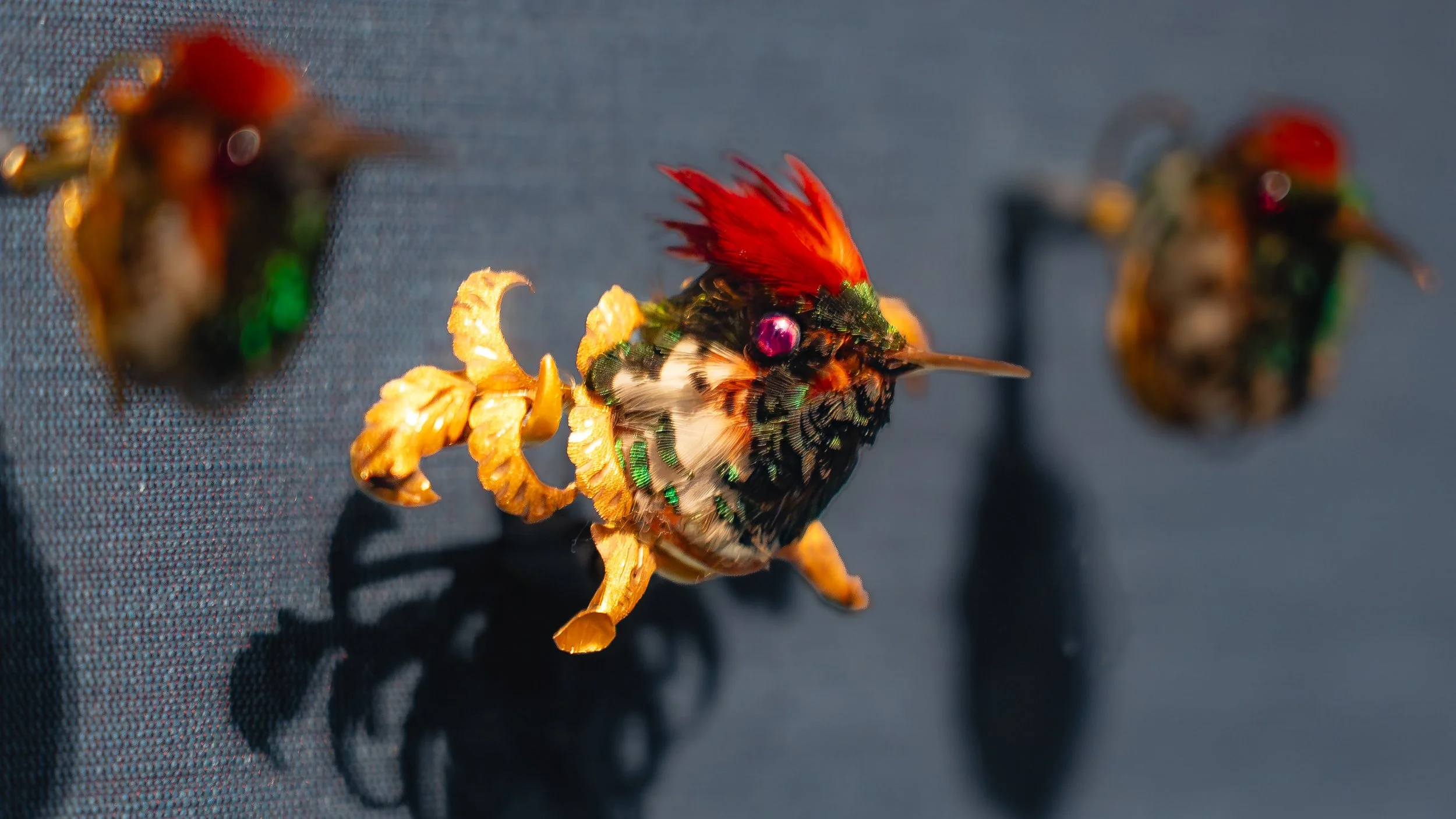
Deathly Adornment: Suite of Hummingbird Jewelry
A suite of hummingbird jewelry—brooch and earrings—combines taxidermied hummingbirds with gold and gemstones, transforming the bodies of living birds into objects of luxury and adornment. Made in the nineteenth century, the suite belongs to a period when feathers and whole birds became fashionable materials, turning avian beauty into a commodity for the human body.
The object reveals a darker counterpart to the natural-history specimen. Like the birds collected by ornithologists and artists such as Martin Johnson Heade, John Gould, and John James Audubon, these hummingbirds have been removed from their ecological context and preserved for human observation. But here preservation becomes ornament: feathers, iridescence, and bodily form are valued not as evidence of a living species, but as precious materials.
The nineteenth-century fashion for bird plumage placed enormous pressure on wild bird populations. The feather trade killed birds on an industrial scale, with feathers and even whole birds used in hats, clothing, and accessories. Hummingbirds were specifically targeted; by the early twentieth century, conservation organizations and the millinery trade were already negotiating restrictions on the importation, manufacture, purchase, and sale of hummingbird plumage. The broader plume trade became so destructive that it helped catalyze the American bird-conservation movement, including the founding of the Massachusetts Audubon Society by Harriet Hemenway and Minna Hall in Boston in 1896.
Within Ornamental Iridescence, the jewelry provides an unsettling parallel to the project’s investigation of Heade. The hummingbird's extraordinary color made it simultaneously a subject of scientific inquiry, artistic representation, collecting, and commercial desire. What appears as ornament is therefore also evidence of a historical system in which the beauty of birds could become a justification for their destruction.
The suite asks a question that runs throughout this project: what happens when the desire to preserve, reproduce, or possess the beauty of the natural world becomes detached from the living systems that produce it? Here, the hummingbird has been made permanent—but only by making it dead.
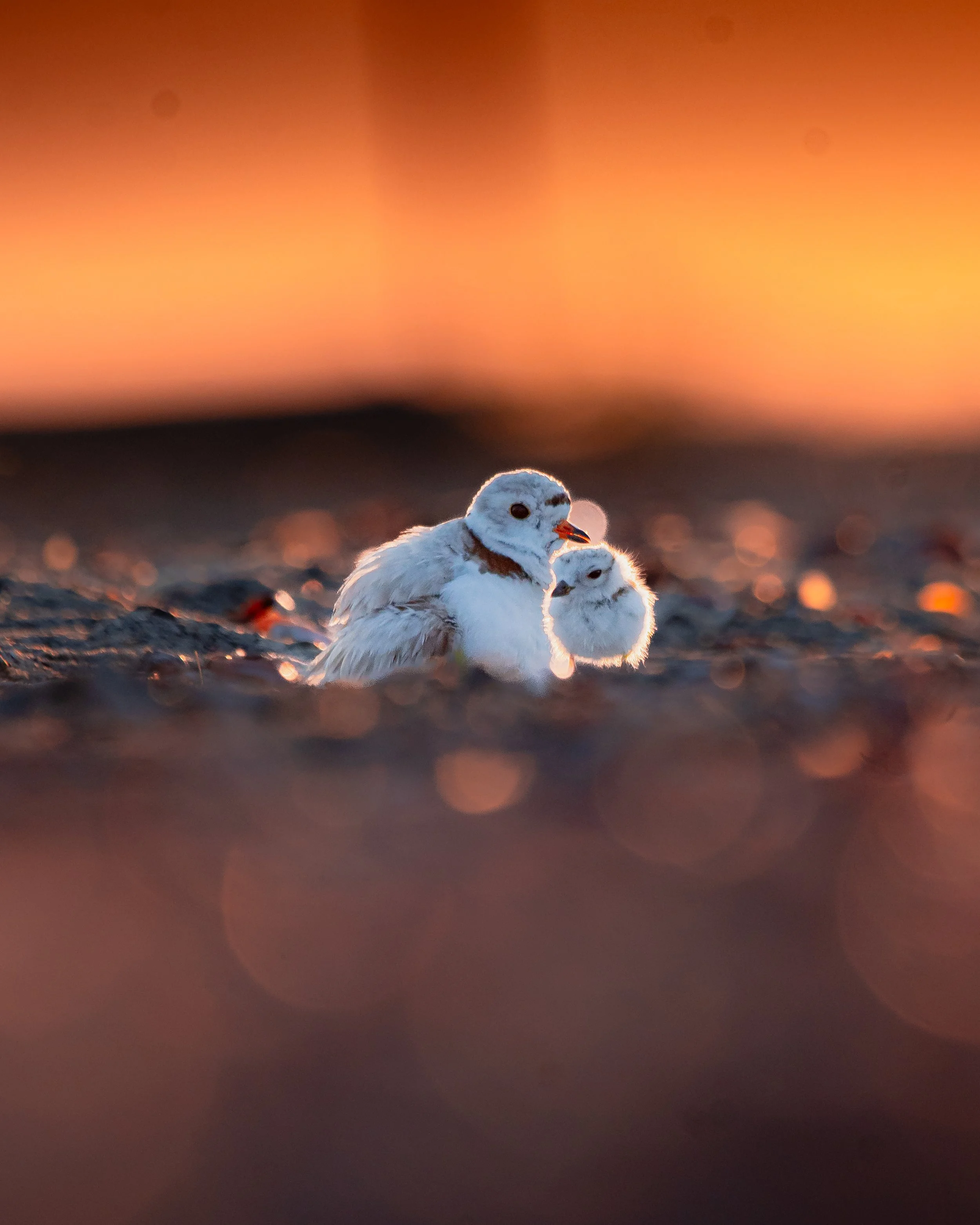
Precarity: Piping Plovers at Sunrise
A Piping Plover and newly hatched chick rest on the beach as the rising sun illuminates the horizon in orange. The image places a vulnerable species within the atmospheric landscape that sustains it, connecting individual life to habitat, reproduction, and the changing conditions of the coast. Heade frequently positioned birds within expansive landscapes, but this photograph shifts that relationship toward contemporary ecological concerns: the beach is simultaneously a beautiful landscape and essential habitat. Photographing birds in their environments allows my practice to consider conservation not as an abstract issue, but as a relationship between living animals and the increasingly contested spaces on which they depend.
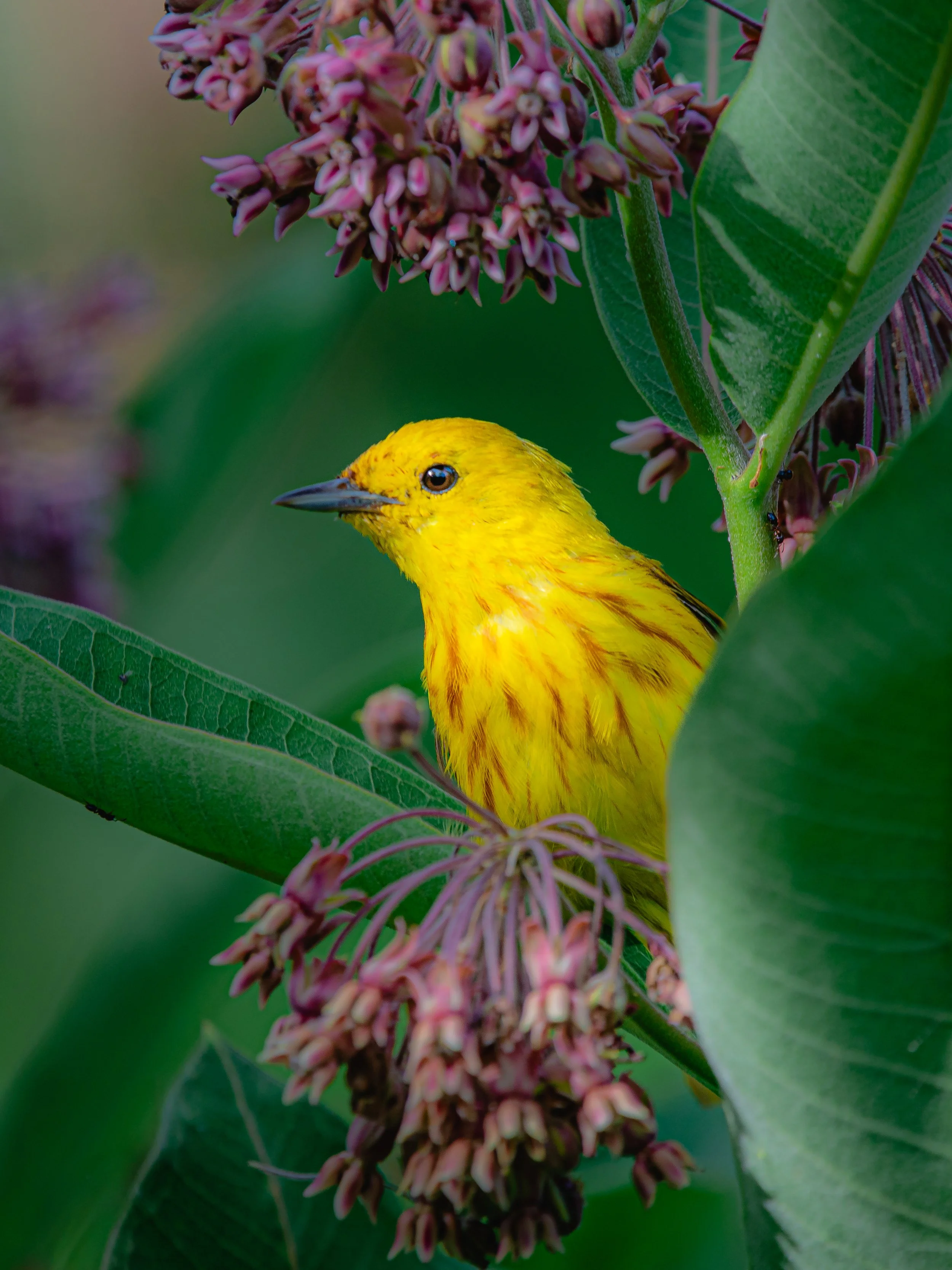
Yellow Warbler on Purple Milkweed
A Yellow Warbler pauses among the blossoms of purple milkweed, its brilliant yellow plumage set against deep violet flowers. The super-telephoto perspective isolates the bird while retaining its botanical environment, allowing color, habitat, and animal behavior to coexist within the frame.
My practice photographing New World warblers during migration has made me increasingly interested in birds as participants in ecological systems rather than simply as photographic subjects. Observing and studying migratory birds has drawn my attention to the connections between habitat, movement, seasonality, and conservation across enormous geographic distances. Like Heade’s placement of hummingbirds within richly observed botanical environments, this photograph uses the relationship between bird and plant as an entry point into a larger ecological story.
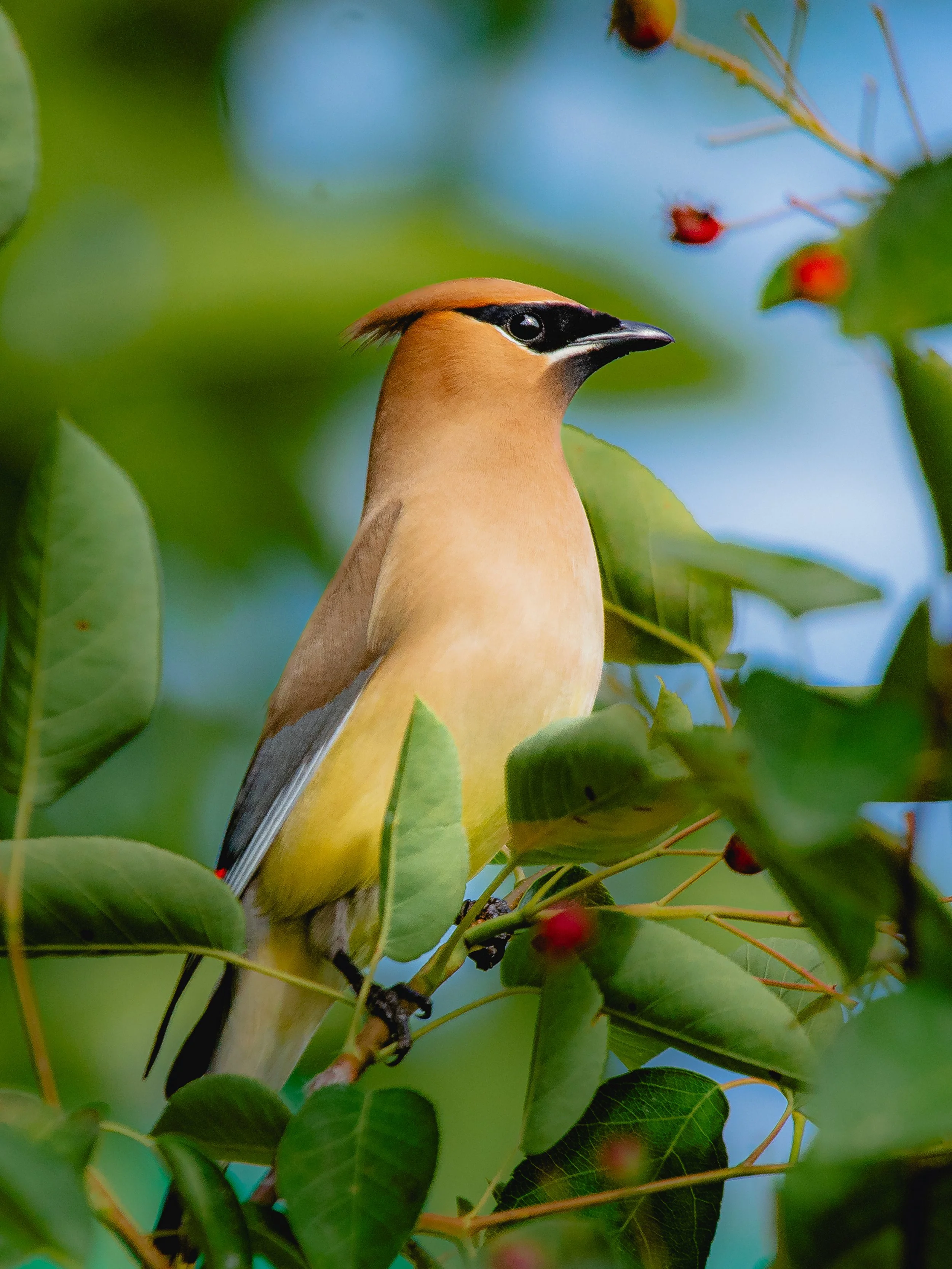
Dispersal: Cedar Waxwing Among the Berries
A Cedar Waxwing perches among clusters of ripe berries, its soft plumage surrounded by an abundance of fruit. The image captures the bird not as an isolated specimen but as an active participant in the life of the landscape. By consuming fruit and transporting seeds through the landscape, birds such as Cedar Waxwings contribute to plant regeneration and the dispersal of vegetation.
The photograph continues my interest in the ecological relationships embedded within images of birds and plants. Heade’s paintings similarly place birds within botanical worlds, but contemporary wildlife photography can observe these relationships as living processes. The telephoto lens allows me to work at a distance while preserving the intimacy of the encounter, connecting aesthetic observation to ecological storytelling.
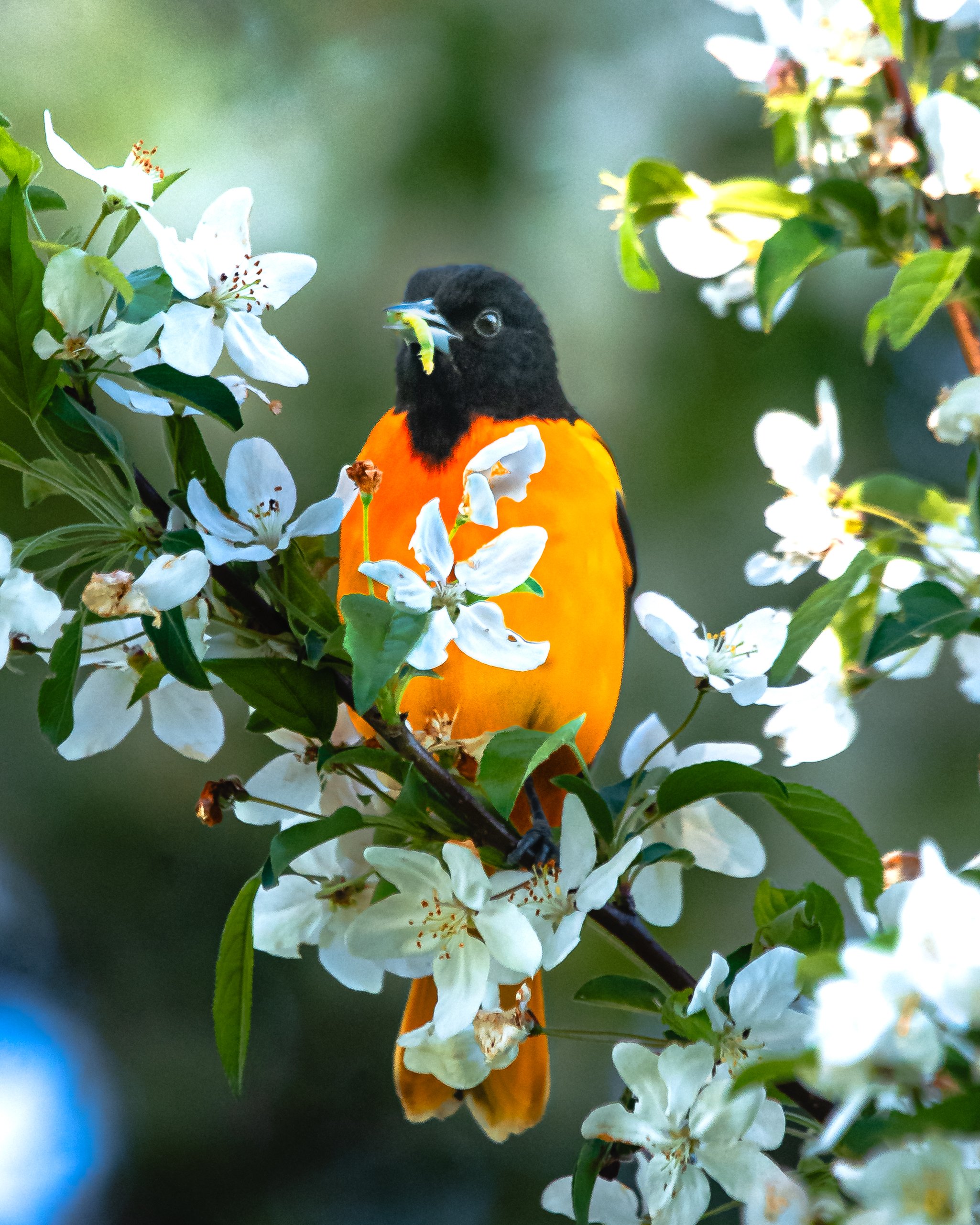
Voracious: Baltimore Oriole
A Baltimore Oriole clings to a flowering cherry tree, its brilliant orange plumage contrasting with the small green caterpillar it has captured. The photograph records a seemingly quiet moment of beauty, but the encounter is also an expression of the constant energetic demands of avian life. For birds, survival depends upon an ongoing search for calories: every flight, migration, territorial defense, and reproductive effort carries an energetic cost.
This metabolic precarity is particularly acute in hummingbirds. Their extraordinarily rapid metabolism requires them to consume large quantities of food relative to their body size, and during the night many species enter torpor, dramatically lowering their metabolic rate and body temperature to conserve energy until morning. Their spectacular hovering flight and jewel-like appearance therefore conceal an extraordinary physiological vulnerability.
The image invites a shift in how we understand the aesthetic beauty of birds. Like Heade’s hummingbirds, the oriole can appear almost ornamental when isolated within a frame. Yet the living bird is not an ornament or specimen; it is an organism continuously negotiating energy, habitat, predation, reproduction, and seasonal change. Beauty and precarity are inseparable.
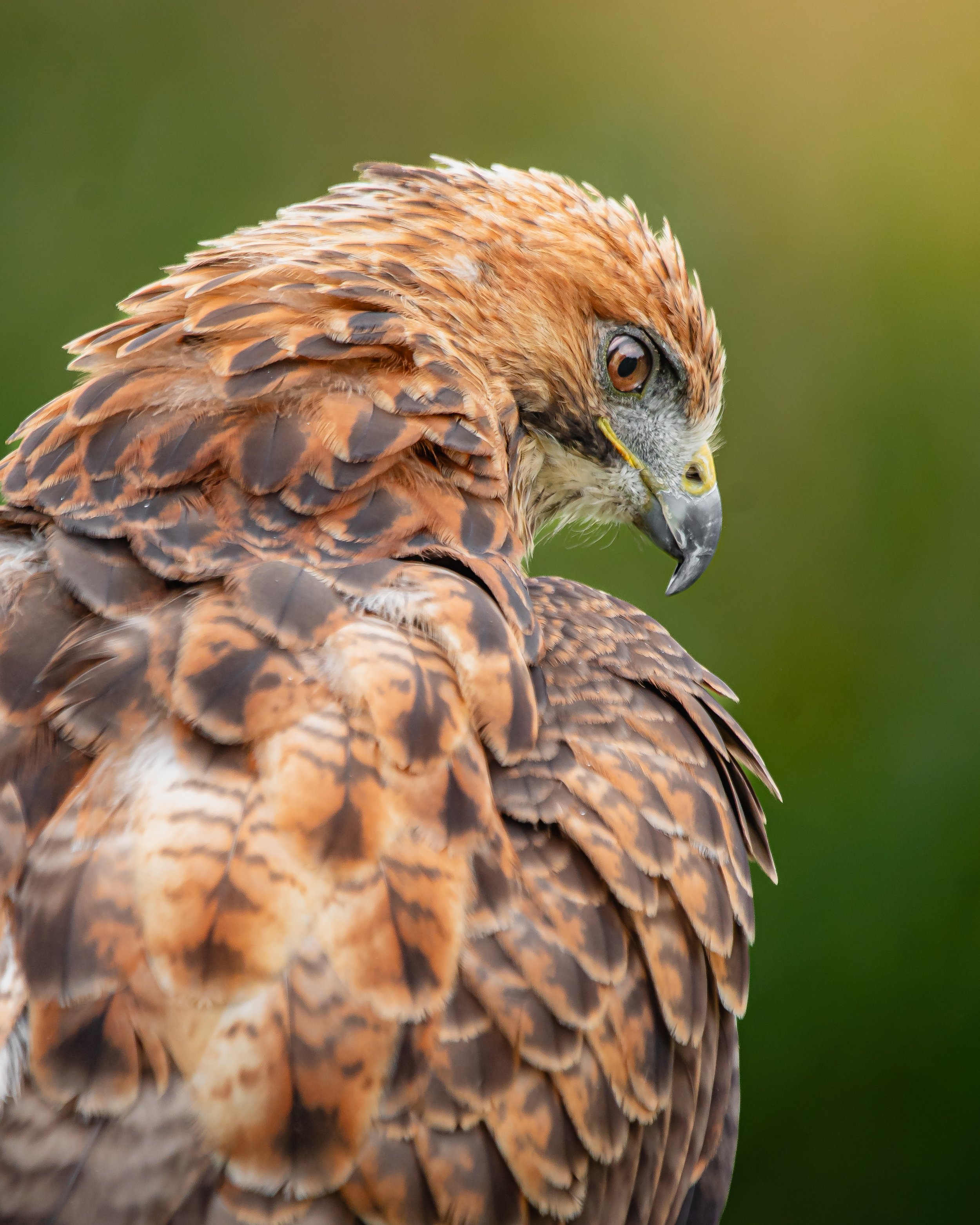
Predatory: Red-tailed Hawk
A Red-tailed Hawk turns sharply over its shoulder, glaring with an intense, almost dragon-like stare. Captured with a high-resolution super-telephoto lens, the portrait resolves individual feathers, the architecture of the eye, and subtle variations in plumage.
Although hummingbirds currently occupy only a small portion of my portfolio, years of wildlife photography have developed the technical and observational skills required to pursue them. Photographing birds demands an understanding of behavior, patience, precise timing, and the ability to work at great distances without disrupting the subject. This established practice provides the foundation from which I intend to pursue the far more specialized challenge of photographing tropical hummingbirds and their habitats.
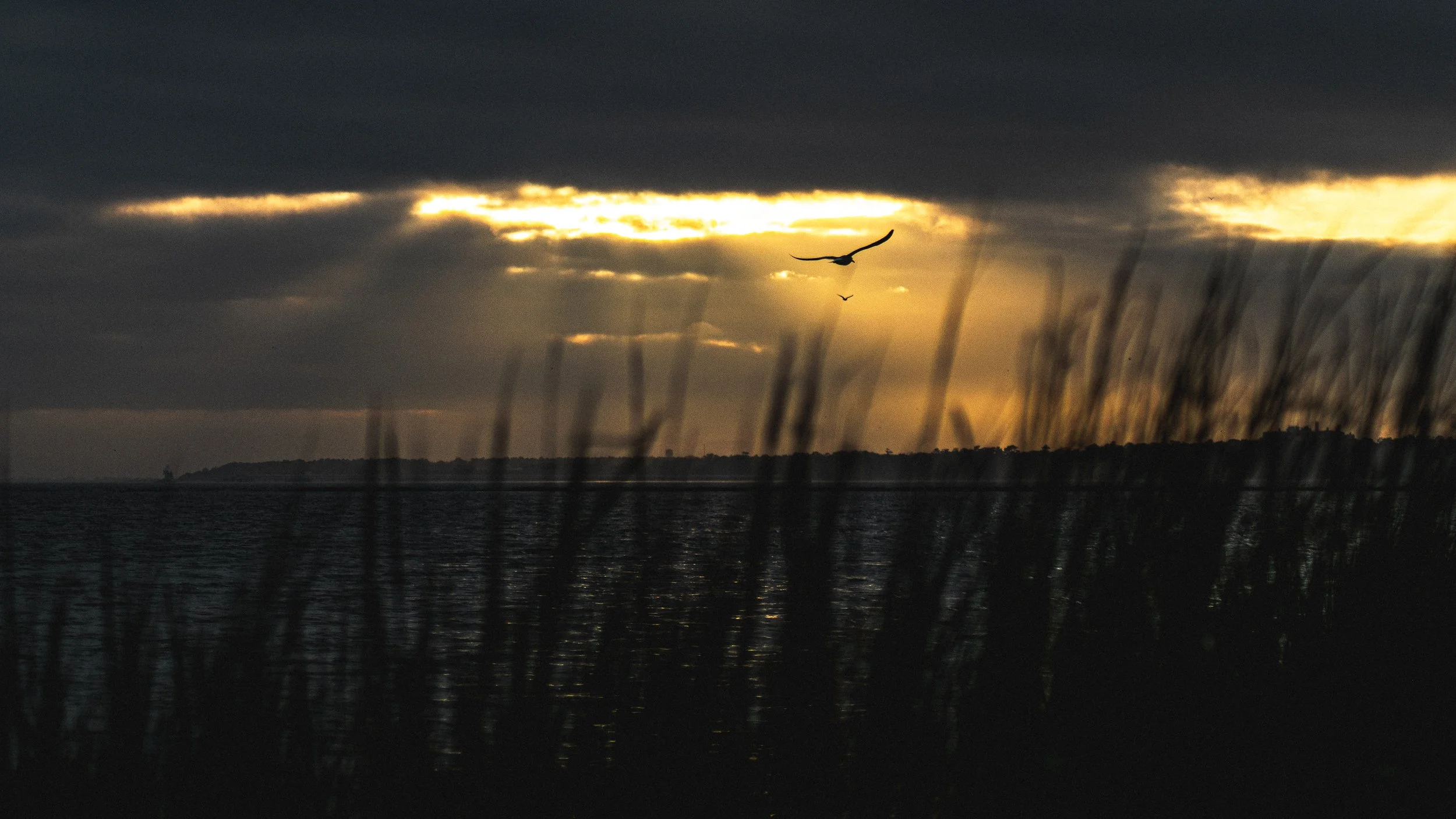
Coast: Seagulls Soaring into Sunset, Fort Fisher
Gulls move across a storm-darkened horizon as the last yellow light breaks through the clouds, turning the sky into bands of shadow and illumination. The photograph recalls Heade’s atmospheric landscapes, in which weather, light, and the shifting conditions of the natural world become subjects in themselves.
Here, the birds are both inhabitants of the coastal ecosystem and fleeting forms within an atmospheric field. Their movement connects the intimate scale of the individual animal to the larger landscape, reinforcing my interest in using bird photography to tell stories about habitat, migration, and ecological interdependence.
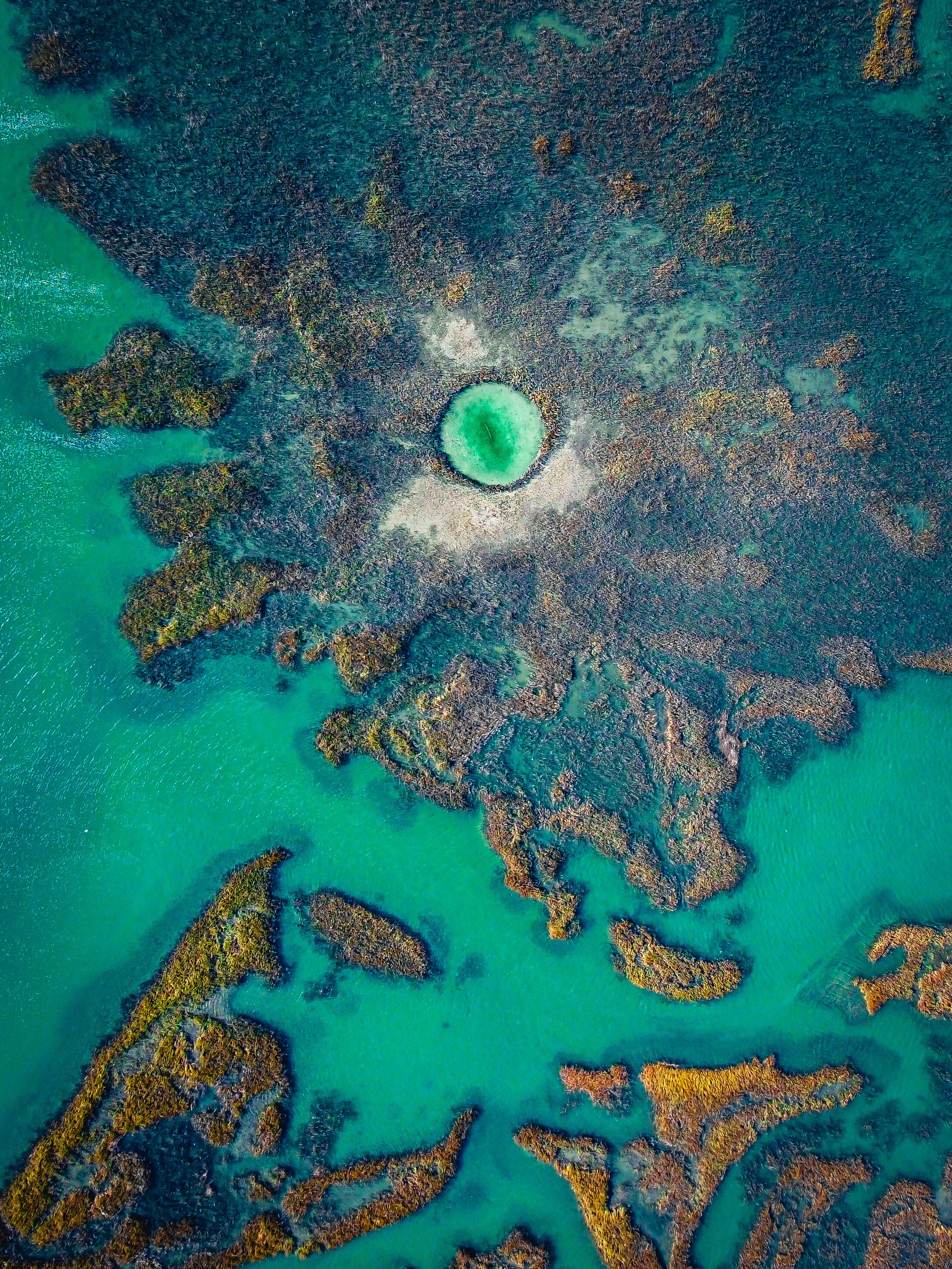
Olokun: Top-Down Over Banks Channel
Seen from above, a natural pool opens within the teal-green wetlands of southeastern North Carolina, its irregular edges dissolving into channels, grasses, and tidal vegetation. The aerial perspective transforms the coastal landscape into an abstract field of interconnected forms.
Heade’s Gems of Brazil brought individual birds and plants into carefully constructed relationships with their environments. A contemporary drone introduces another way of observing those relationships: rather than approaching nature from ground level, the camera moves above it, revealing patterns and connections that remain invisible from the surface. The resulting image shifts landscape from scenery toward system.
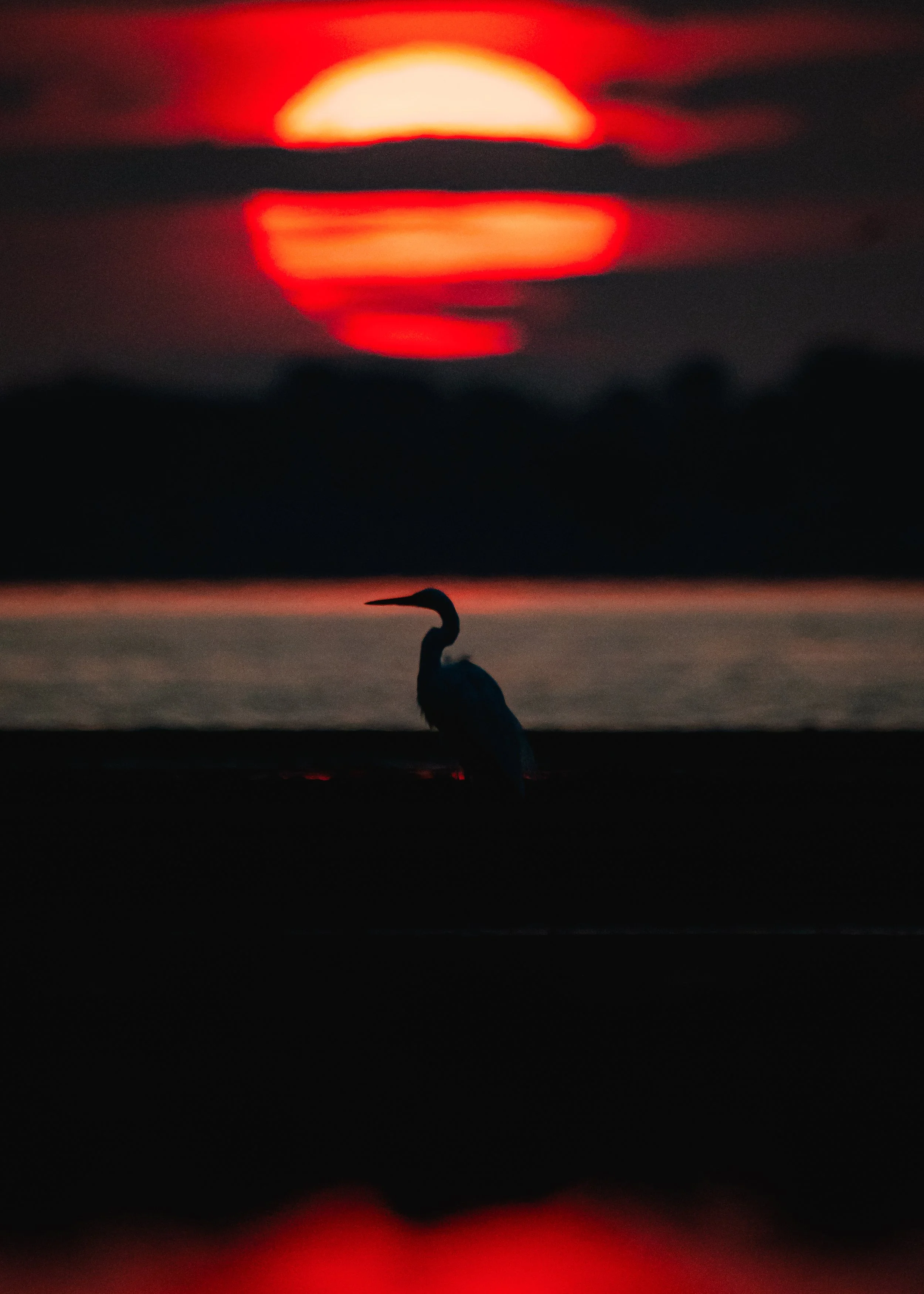
Daybreak: Egret at Dawn
A Snowy Egret stands in silhouette as the sun breaks the horizon, its slender form emerging against a field of saturated orange. The telephoto lens compresses distance between bird and sun, transforming the egret into a dark, almost graphic presence within an atmospheric landscape.
The photograph extends my interest in the relationship between birds and the changing conditions of their habitats. At dawn, the image exists at the intersection of animal, landscape, and light: the egret is simultaneously a living creature, a resident of a wetland ecosystem, and a fleeting form within an atmospheric event.
The image also recalls Martin Johnson Heade’s sustained fascination with sunrise and sunset, in which subtle changes in illumination transform the landscape into something almost ephemeral. Like Heade, I am interested in the moment when light becomes the subject itself. Contemporary photography, however, introduces another way of preserving that transition, using the camera to arrest a fleeting encounter between bird, horizon, and light and make it available for sustained attention.
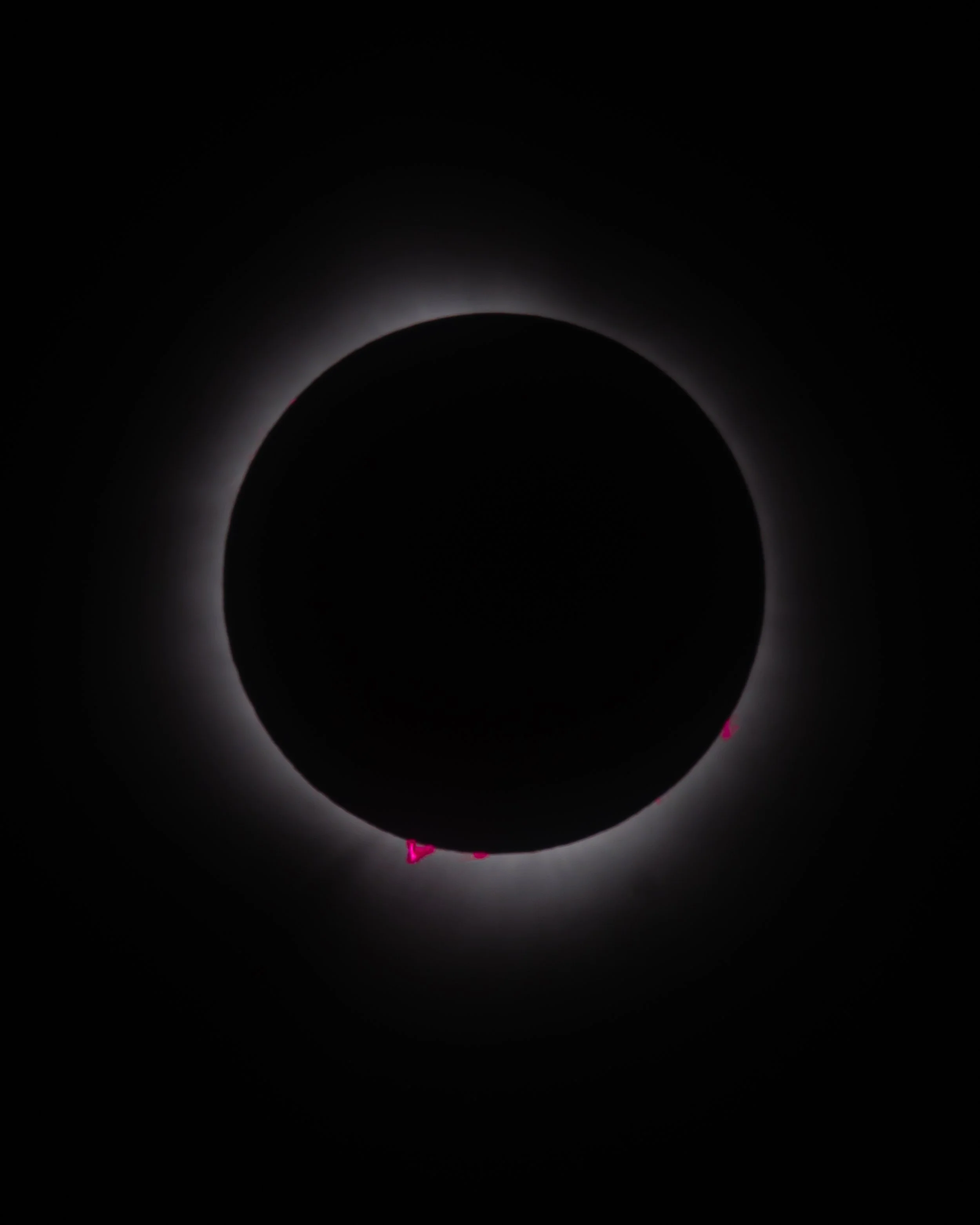
Totality: Solar Flare
During totality, the Moon passes directly between Earth and the Sun, reducing daylight to an extraordinary twilight as the Sun’s corona radiates around the dark lunar disk. A solar prominence extends from the Sun’s edge, revealing an eruption of plasma otherwise invisible during ordinary daylight. The photograph brings together two fleeting phenomena—the precise alignment of an eclipse and the constantly changing activity of the Sun—within a single frame.
The image extends Martin Johnson Heade’s fascination with transient light and atmospheric phenomena into the celestial realm. Where Heade used paint to preserve fleeting effects of illumination across the landscape, contemporary digital imaging can record phenomena that unfold beyond the limits of unaided vision. Totality therefore becomes both a document and an instrument of observation, asking how technology expands our capacity to see, preserve, and understand the natural world. It continues the central investigation of Ornamental Iridescence: not simply what nature looks like, but how the tools we use to see it shape what becomes visible.
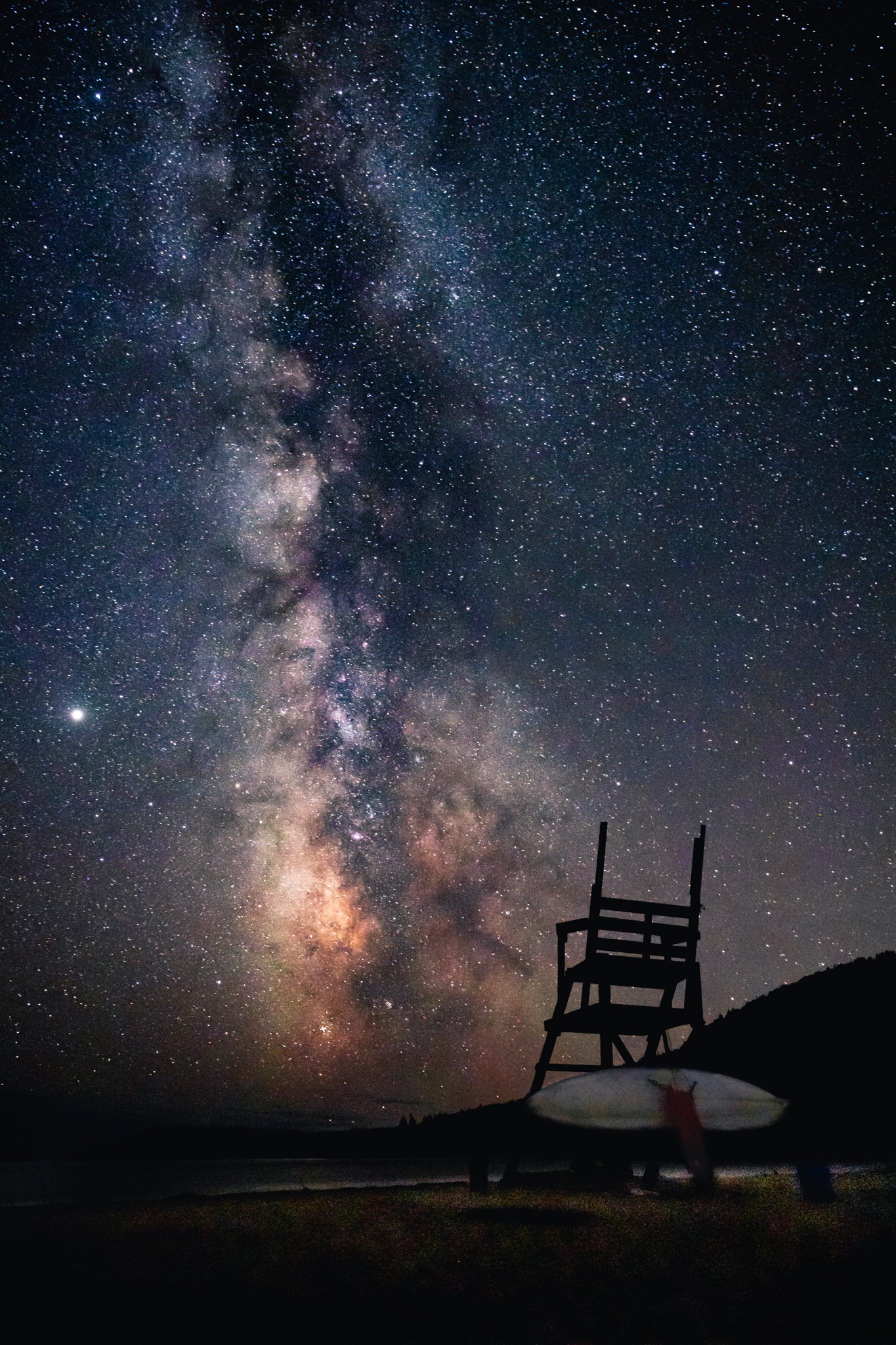
Gravity: Milky Way Over Sandy Beach
The Milky Way rises above the Atlantic Ocean beyond an empty lifeguard stand, a structure built for watching a landscape that now extends far beyond the limits of unaided vision. Martin Johnson Heade’s paintings repeatedly explored light and atmospheric phenomena at the threshold of perception. Contemporary digital imaging extends that inquiry into the night: through long exposure and the sensitivity of modern cameras, stars and subtle variations in color emerge that remain largely invisible to the unaided eye.
Like Heade’s attempts to translate fleeting atmospheric phenomena into paint, the photograph transforms imperceptible or transient light into a visible record. The empty lifeguard stand becomes a metaphor for the project itself: an instrument for looking toward a world that exceeds ordinary human perception, and a reminder that every technology of seeing also shapes what we understand as nature