 Image 1 of 2
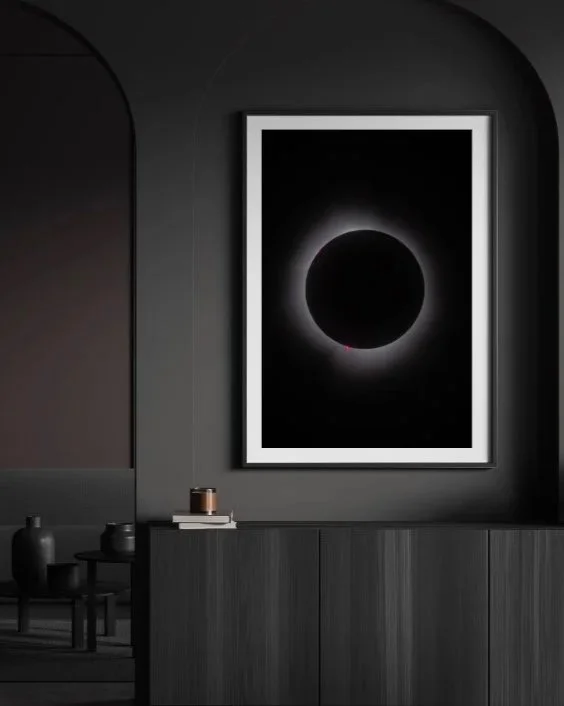 Image 2 of 2
“…Praise the dark, the moon cradle The sky fall, the bear sleep— Praise the mist, the warrior name The earth eclipse, the fired leap…”
— Joy Harjo, “Praise the Rain”
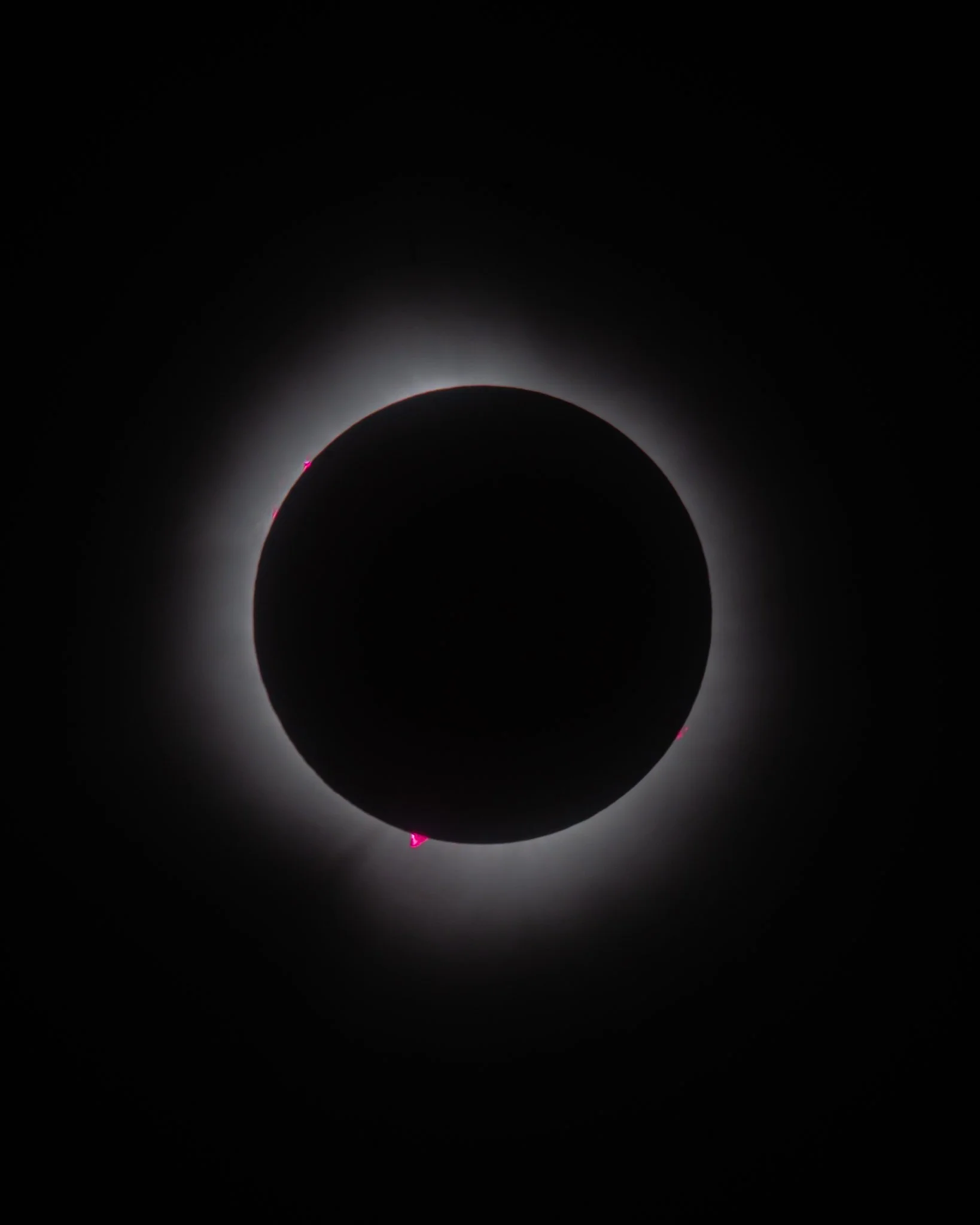
During totality, the Moon passes directly between Earth and the Sun, reducing daylight to an extraordinary twilight as the Sun’s corona radiates around the dark lunar disk. A solar flare extends from the Sun’s edge, revealing an eruption of plasma otherwise invisible during ordinary daylight. The photograph brings together two fleeting phenomena—the precise alignment of an eclipse and the constantly changing activity of the Sun—within a single frame.
This solar eclipse was the first that I have ever been able to witness, and it was nothing short of miraculous. I had planned on capturing the moment from Burlington, Vermont, so I got on the highway from my apartment in Connecticut with what I thought would be plenty of time to spare. As I crossed the border in Massachusetts, I got stuck in bumper to bumper, nearly stand still traffic. What was estimated as a three and a half hour trip on a normal day took over seven. As I passed the exit for King Philip’s Stockade in Springfield, I decided to put on a podcast about Metacomet’s War where I learned that a lunar eclipse occurred on June 27, 1675, which Indigenous tribes intuited as a spiritual omen signifying favor for their resistance against colonial occupation, propelling them to intensify their offensive. I also learned that on February 12, 1831, Nat Turner also interpreted a solar eclipse as a prophetic herald to revolt and overthrow chattel slavery; it signaled him to begin organizing for the revolt in Southhampton, VA later that August.
As I patiently made my way toward the path of totality in Vermont, it started becoming apparent that I wasn’t going to reach Burlington in time to set up a tripod, camera, and solar photography filter, so I decided to pull over at a rest area crowded with fellow travelers with the same mindset. I serendipitously ran into a Divinity School comrade on my way back to the car from the bathroom, and the energy was palpable. Audiences set up lawn chairs, cameras, and spotting scopes, watching eagerly as the moon and sun converged. My anticipation oscillated between dreadful anxiousness and joyful excitement. The next total eclipse visible in the contiguous US states won’t happen until August 22, 2044, and will touch only Montana and North Dakota, so I knew that I wanted to make the most of the moment. I had never attempted to capture an eclipse, but I had recently invested in a new (used) 150-600mm super-telephoto lens to capture the event, and I was nervous that I wouldn’t be able to meet the moment. At the same time, I wanted to make sure I relaxed enough to soak in the experience of a moment that I may never again experience in my life.
An aura of stillness set in the air when the eclipse began. As the landscape was plunged into darkness, the birds stopped chirping, the insects stopped buzzing, and the Earth stood still. For the next few minutes, I was able to get comfortable with camera settings, and soak up the darkness.
The eclipse also the final day of Ramadan, and after a long month of fasting and rekindling my relationship to Allah, the experience was especially spiritual for me. It reminded me of Hadith 1048, "The sun and the moon are two signs amongst the signs of Allah and they do not eclipse because of the death of someone but Allah awes His devotees with them."